
How Chinese Manufacturers Support OEM Type 2 AC Sockets
 2026-10-15

For electric vehicle charging equipment manufacturers, an AC socket is not simply a component purchased at the end of production. Its design influences charging station layout, electrical connections, installation efficiency, and everyday operation.
This is especially true for Type 2 AC sockets used in European-style charging systems. OEM manufacturers need suitable current ratings, dependable contact materials, environmental protection, and mechanical configurations that fit their charging equipment.
Chinese manufacturers have become important suppliers in this sector by offering specialized charging components and supporting the technical requirements of international equipment producers.
Zhangjiagang UCHEN New Energy Technology Co., Ltd., referred to as Youcheng Technology (stock code: 873087), focuses on developing and promoting high-performance charging products for new energy vehicles.
Through its DUOSIDA brand, the company provides Type 2 AC sockets, charging plugs, charging cables, and other electrical connection products. Its product range offers practical options for businesses sourcing components for OEM charging station projects.
OEM Development Begins With the Charging Station Design
Consider a European charging equipment company developing a new wall-mounted AC charging station.
The design team has selected a compact enclosure and defined the intended charging capacity. However, the socket must still fit the front panel, connect to the internal wiring, and withstand repeated charging operations.
The choice of socket affects several parts of the final product.
A larger connector housing may require changes to the enclosure. An unsuitable terminal arrangement can complicate wiring assembly. Insufficient environmental protection may create problems for outdoor installations.
For these reasons, OEM development should begin with the charging station's electrical and mechanical requirements.
An effective Chinese Type 2 AC socket manufacturer can support this process by offering defined product configurations, technical specifications, and model-specific installation information.
Rather than selecting a socket based only on appearance, equipment manufacturers should compare the complete electrical and mechanical design with their intended charging application.
DUOSIDA Type 2 AC Socket Options for OEM Projects
Youcheng Technology provides several Type 2 AC socket configurations through its DUOSIDA product portfolio.
Two useful examples illustrate how different socket designs can serve different equipment requirements.
The specifications below are based on the corresponding published DUOSIDA product pages.
Type 2 AC Socket With 16A, 20A, 32A and 50A Ratings
The DUOSIDA Type 2 AC Socket rated at 16A, 20A, 32A and 50A is designed for charging station electrical connections.
Its published features include:
Operating voltage: 250V/415V AC.
Rated current options: 16A, 20A, 32A and 50A.
Rear-mounted installation with crimped terminals.
Clamshell protective cover.
IP54 protection under the stated working condition.
Operating temperature range from -30°C to +50°C.
Copper-alloy, silver-plated contacts.
Thermoplastic housing with UL94 V-0 flame-retardant classification.
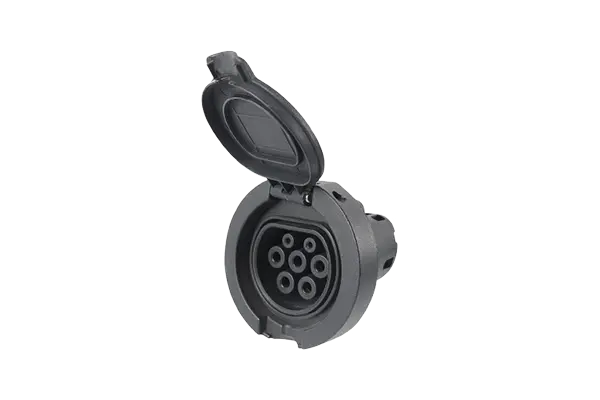
The product page also specifies a no-load mechanical insertion and withdrawal lifespan exceeding 10,000 cycles.
For OEM manufacturers, this configuration is relevant when developing socket-equipped charging stations requiring suitable front-panel installation and electrical connection arrangements.
The clamshell protective cover is another consideration for equipment designers evaluating how the charging socket will be protected during daily use.
Type 2 AC Socket With Shutter and Cover
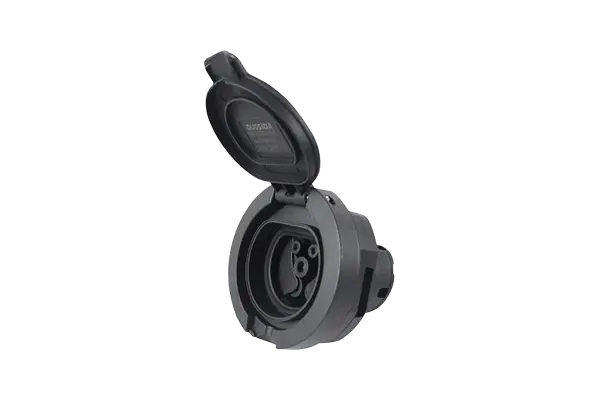
Another option is the DUOSIDA Type 2 AC Socket operating at 250V/415V AC.
This version features a shutter and cover, providing a different protective structure from the clamshell-cover model.
Its published specifications include:
Parameter | Product Specification |
|---|---|
Operating voltage | 250V/415V AC |
Rated current options | 16A, 32A, 50A, 63A |
Installation | Rear-mounted, crimped terminals |
Protection rating | IP55 under stated working conditions |
Mechanical lifespan | Over 10,000 no-load insertion/withdrawal cycles |
Contact resistance | Maximum 0.5 mΩ |
Terminal temperature rise | Below 50K under stated test conditions |
Operating temperature | -30°C to +50°C |
The socket uses thermoplastic structural components and silver-plated copper-alloy terminals.
For charging station manufacturers, the shutter-and-cover arrangement may be useful when evaluating protective features for a particular installation environment.
However, the final choice should consider enclosure design, installation conditions, local requirements, and complete equipment testing.
Matching Socket Models to OEM Electrical Requirements
Selecting the appropriate current rating is one of the most important decisions in an OEM charging station project.
A charging station designed for a particular AC output must use components whose ratings are compatible with the complete electrical system.
DUOSIDA publishes specific model and cable configurations for its Type 2 AC socket products.
For example, the 16A model uses a published cable specification of 3 × 2.5 mm² plus 2 × 0.75 mm² for single-phase applications.
The 32A single-phase configuration lists 3 × 6 mm² plus 2 × 0.75 mm², while the 32A three-phase configuration lists 5 × 6 mm² plus 2 × 0.75 mm².
For the shutter-equipped series, a 63A three-phase configuration is also listed, with a cable specification of 5 × 16 mm² plus 2 × 0.75 mm².
These examples show why model selection should address both socket ratings and cable requirements.
The final cable specification must still be evaluated against installation conditions, applicable electrical standards, thermal performance, and charging equipment design.
An OEM manufacturer should not assume that every Type 2 socket configuration can be used interchangeably.
Manufacturing Details That Affect Product Quality
The quality of an AC charging socket depends heavily on its materials and assembly characteristics.
Conductive contacts, insulating structures, terminal connections, and protective housings all contribute to the performance of the finished component.
Contact Materials and Electrical Performance
DUOSIDA's published Type 2 AC socket specifications identify copper-alloy contacts with silver-plated surfaces.
These materials are relevant to electrical conductivity, contact performance, and resistance to wear during repeated connections.
The company also publishes contact-resistance and temperature-rise specifications for its socket models.
For OEM customers, these measurable characteristics provide a more useful basis for evaluation than general claims about connector quality.
Housing Design and Installation
The socket housing must provide mechanical support while maintaining the required insulation between electrical contacts.
DUOSIDA's Type 2 AC socket range includes thermoplastic housing structures, rear-mounted configurations, and crimped terminal connections.
These features influence how the component is installed within a charging station.
For manufacturers assembling charging equipment in production batches, consistent mounting dimensions and terminal arrangements can make assembly procedures easier to standardize.
Before approving a model, the OEM team should verify drawings, mounting clearance, wiring orientation, and the intended installation process.
Mechanical Durability
Charging station sockets may experience frequent insertion and withdrawal cycles.
DUOSIDA publishes a mechanical lifespan exceeding 10,000 no-load cycles for the two Type 2 AC socket examples.
This provides a defined mechanical performance specification for engineering review.
It should not, however, be interpreted as a guarantee of unlimited service life under every charging environment. Actual durability depends on operating conditions, connector compatibility, maintenance, and other factors.
Supporting International Charging Equipment Standards
Type 2 charging interfaces are widely associated with AC charging infrastructure in Europe.
The international standard IEC 62196-2 establishes dimensional requirements for AC charging plugs, socket-outlets, vehicle connectors, and vehicle inlets.
DUOSIDA identifies IEC 62196-2 conformity in its published Type 2 AC socket product descriptions.
For international OEM projects, the applicable edition of the standard and supporting test evidence should be confirmed during technical approval.
The socket is also only one element of the overall charging station.
Equipment manufacturers must consider additional requirements relating to charging control, electrical protection, installation, and complete system safety.
This distinction matters because using a standards-based socket does not automatically establish compliance for the finished charging station.
How Chinese Manufacturers Can Support Production Projects
An OEM cooperation project normally involves more than supplying individual components.
The process often begins with discussions about the intended charging application, followed by model selection, sample testing, assembly evaluation, and production planning.
For example, a charging station manufacturer may initially select a 32A Type 2 AC socket but discover during prototype assembly that the enclosure requires additional clearance behind the mounting panel.
Reviewing mechanical drawings before finalizing the enclosure can help prevent unnecessary redesign.
Similarly, the wiring team may need to confirm whether a proposed terminal arrangement is compatible with its established cable preparation and crimping processes.
These are practical issues that require accurate technical communication between the OEM customer and component manufacturer.
As a specialized charging products provider, Youcheng Technology offers a defined range of Type 2 AC socket options that customers can evaluate during these development stages.
Any project-specific customization, modified assembly, or special supply arrangement should be discussed and confirmed directly rather than assumed from standard catalogue products.
Beyond Type 2 AC Sockets: Related DUOSIDA Products
For companies developing electric vehicle charging equipment, sourcing often extends beyond a single AC socket.
The DUOSIDA charging product portfolio includes charging plugs, charging cables, charging sockets, charging modes, and other connection products.
The company also offers high-voltage connector products for electrical connection applications requiring different connector structures and operating specifications.
Although these high-voltage connectors perform different functions from Type 2 AC charging station sockets, they expand the range of components available for evaluation across electric vehicle and charging-related projects.
For purchasing and engineering teams, access to multiple relevant product categories can provide a more convenient starting point for discussing broader component requirements.
From a Standard Socket to an OEM Charging Solution
A successful OEM Type 2 AC socket project depends on matching the component to the equipment rather than adapting the equipment around an unsuitable component.
Current rating, operating voltage, mechanical dimensions, terminal design, environmental protection, and applicable standards must all be considered during product development.
Youcheng Technology provides Type 2 AC socket products with multiple current ratings and protective structures, giving charging equipment manufacturers options for different installation requirements.
Its wider DUOSIDA product portfolio also supports discussions involving related charging components and high-voltage electrical connections.
For manufacturers developing new AC charging stations or updating existing equipment, the most productive approach is to begin with detailed electrical requirements, enclosure drawings, and intended operating conditions.
With this information, the manufacturer and OEM customer can identify appropriate Type 2 AC socket configurations, review technical documentation, and establish a clear basis for sample evaluation and production cooperation.