
What Should EV Manufacturers Look for in a DC Vehicle Inlet Supplier?
 2026-10-14

A DC vehicle inlet may be a relatively small component in an electric vehicle, but choosing the wrong one can create significant problems during vehicle development. Poor mechanical fit, unsuitable current ratings, excessive temperature rise, or incomplete technical documentation can delay validation and complicate production.
For electric vehicle manufacturers, selecting a DC vehicle inlet supplier is therefore more than a purchasing decision. It involves checking whether the supplier can support the vehicle's charging architecture, installation requirements, applicable standards, and long-term production needs.
This becomes particularly important when working with high-voltage charging systems, including 1000V DC vehicle inlets. Manufacturers need to understand not only the inlet's rated voltage but also its current-carrying capability, electrical connections, environmental resistance, and compatibility with the intended charging infrastructure.
A reliable supplier should be able to provide clear specifications, suitable product options, relevant testing evidence, and practical engineering support.
Why DC Vehicle Inlet Selection Should Begin Early
Consider an electric commercial vehicle manufacturer developing a new platform for urban delivery operations.
The engineering team has already selected a battery architecture and charging strategy. However, the vehicle's charging inlet must still fit within the available body space, connect to the high-voltage wiring system, and operate reliably under repeated charging cycles.
If the inlet is selected too late, several problems may arise:
The mounting dimensions may not match the charging port opening.
Cable routing may interfere with nearby vehicle components.
The selected inlet may not support the required continuous charging current.
Environmental sealing may be unsuitable for the installation location.
Additional validation may be needed before production approval.
These issues explain why experienced EV manufacturers involve charging connector suppliers during the design and prototype stages rather than waiting until the purchasing process begins.
Match the Electrical Specifications to the Vehicle
One of the first questions manufacturers should ask is whether the inlet's electrical ratings meet the vehicle's operating requirements.
Voltage alone is not enough to determine suitability.
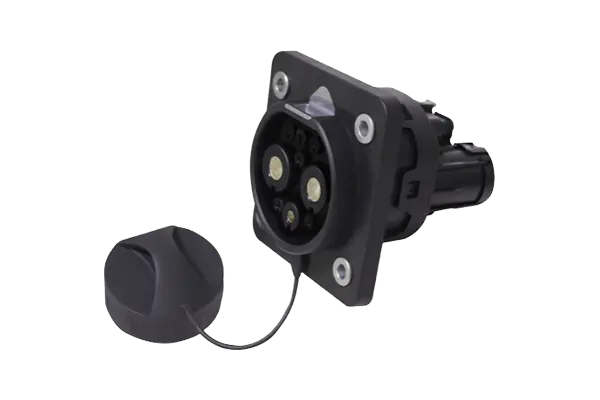
For example, the GB/T DC Vehicle Inlet with 1000V DC operating voltage offered by DUOSIDA provides a relevant product reference for manufacturers evaluating GB/T DC charging interfaces.
A 1000V DC operating voltage rating identifies an important electrical characteristic, but manufacturers must also confirm the exact rated current, supported cable configuration, and applicable operating conditions for the selected model.
The following information should be reviewed during technical evaluation:
Technical Parameter | Why It Matters |
|---|---|
Rated operating voltage | Must suit the vehicle's charging voltage range |
Rated current | Determines the inlet's supported current under specified conditions |
Contact resistance | Influences electrical losses and heat generation |
Insulation resistance | Helps assess electrical insulation performance |
Temperature rise | Indicates thermal behavior during current loading |
Cable specifications | Affects termination, installation, and current-carrying capability |
Withstand voltage | Supports insulation verification |
Manufacturers should request the relevant test conditions alongside the electrical ratings. A specification without its measurement conditions may not be sufficient for engineering approval.
Check Charging Standards and Market Compatibility
An inlet designed for one charging standard cannot automatically be installed in a vehicle intended for another charging market.
GB/T DC charging interfaces are used in the Chinese electric vehicle charging ecosystem. The current GB/T 20234.3-2023 standard addresses DC charging couplers, including requirements relating to ratings, connection interfaces, contact arrangements, and structural dimensions.
For manufacturers developing vehicles for different markets, connector selection should take regional charging infrastructure into account.
For example, a vehicle platform intended for China may require a GB/T DC interface, while another market version may use CCS2 or a different charging system.
A supplier should help the engineering team clarify three separate questions:
Does the physical charging interface match the target charging standard?
Are the inlet's electrical ratings suitable for the vehicle?
Has the complete vehicle charging system been designed to support the required communication and charging control functions?
These questions cannot be answered by connector dimensions alone.
Suppliers should also provide documentation identifying the applicable standard edition. Older test reports may not be sufficient when the vehicle program requires compliance with updated requirements.
Evaluate the Charging Port as an Installed Assembly
A vehicle inlet is not installed in isolation. It becomes part of an assembly involving the vehicle body, mounting hardware, wiring harness, sealing components, and sometimes locking mechanisms.
This is where practical design information becomes important.
Mounting and Cable Routing
Before approving an inlet, the engineering team should examine the mounting position, insertion direction, rear clearance, connector orientation, and cable bending space.
For commercial vehicles, charging port locations may be influenced by body design, depot charging arrangements, and maintenance accessibility.
An inlet that fits the outer body opening may still create assembly problems if its rear connections cannot be installed without excessive cable bending.
Protection Against Environmental Exposure
Charging ports are exposed to different environmental conditions depending on the vehicle and operating location.
Manufacturers should evaluate protection against dust and water, temperature variations, vibration, and mechanical wear.
The supplier should clarify whether a stated IP rating applies when the connector is mated, when a protective cap is closed, or under another specific test condition.
This distinction is important because environmental protection cannot always be described by a single rating covering every operating state.
Ask for Evidence of Thermal and Mechanical Reliability
A common mistake during component sourcing is focusing on nominal electrical ratings while giving less attention to long-term operating behavior.
DC charging connectors carry substantial current through mechanical contacts. Contact condition, cable termination, material selection, and thermal behavior all influence performance.
Manufacturers should request evidence from relevant qualification tests rather than relying only on general product descriptions.
Particularly useful evidence includes temperature-rise tests, contact-resistance measurements, insulation tests, insertion and withdrawal cycle testing, and environmental testing.
For a vehicle expected to charge frequently, mechanical durability should be considered alongside electrical performance.
Engineers should also ask whether the supplier can provide inspection criteria for production batches. Consistent contact dimensions and termination quality matter when components move from prototype samples to volume production.
Product Example: Choosing Between Different Connection Solutions
Not every high-voltage connection inside an EV performs the same function.
The DC vehicle inlet connects the vehicle to external charging equipment. Other high-voltage connectors may be used inside the vehicle's battery system, power distribution equipment, motor system, or associated electrical assemblies.
For example, DUOSIDA also offers high-voltage connector products for vehicle electrical applications.
Its portfolio includes different connector structures, such as two-core and three-core plastic connectors. Published product listings include configurations rated at 150A/1000V DC and 200A/1000V DC, as well as a mini maintenance/safety switch listed at 170A/1000V DC.
These are separate product categories, not interchangeable substitutes for a DC vehicle charging inlet.
However, they illustrate why EV manufacturers may benefit from discussing their wider connection requirements with a supplier that understands both external charging interfaces and internal high-voltage connections.
For a new vehicle program, this may help engineering teams coordinate specifications, cable interfaces, and supplier communication across related components.
What Should a Supplier Provide Before Prototype Approval?
A useful way to compare suppliers is to evaluate the documentation they can provide before the first vehicle prototype is approved.
Instead of requesting only a product catalogue, manufacturers should prepare a structured technical review.
Review Item | Documents or Information to Request |
|---|---|
Electrical suitability | Rated voltage, current, insulation and thermal specifications |
Mechanical integration | Dimensional drawings and mounting requirements |
Cable compatibility | Recommended cable sizes and termination information |
Environmental performance | Protection ratings and relevant test reports |
Standards | Applicable GB/T or other standard references |
Quality assurance | Inspection procedures and production quality records |
Production readiness | Lead-time planning, change control and traceability arrangements |
The purpose is not to create unnecessary paperwork. It is to identify potential technical problems before tooling, vehicle testing, and production planning become difficult to change.
For overseas manufacturers, clear English technical documentation and responsive engineering communication can also make the validation process more efficient.
Supplier Communication Matters During Design Changes
EV development projects rarely move from the first prototype directly into production without changes.
Charging port positions may be adjusted. Cable lengths may change. The vehicle's charging current strategy may be revised following thermal testing or battery system development.
A suitable DC vehicle inlet supplier should have a clear process for discussing these changes.
Manufacturers should establish how revised drawings will be reviewed, whether changes affect existing validation results, and how product revisions will be identified.
For example, if a new cable arrangement changes the terminal configuration, the engineering team should determine whether additional electrical or thermal testing is required.
A supplier's ability to provide accurate revision information can be just as important as its original product specifications.
Working With Youcheng Technology on EV Charging Components
Zhangjiagang UCHEN New Energy Technology Co., Ltd., referred to as Youcheng Technology (stock code: 873087), focuses on the development and market promotion of high-performance charging products for new energy vehicles.
Through its DUOSIDA product range, the company provides EV charging sockets, charging plugs, charging cables, high-voltage connectors, and related charging components.
For vehicle manufacturers evaluating DC charging interfaces, the DUOSIDA EV charging solutions portfolio offers a starting point for reviewing available product categories and identifying suitable components for further technical evaluation.
The company's GB/T DC vehicle inlet with a listed 1000V DC operating voltage is particularly relevant to projects requiring a GB/T charging interface.
However, purchasing teams should still confirm the selected model's full specifications, applicable standard compliance, supporting test documentation, and installation requirements directly with the supplier before approving it for a vehicle program.
The objective is to establish a technically suitable connection solution rather than choosing a component based on a single specification.
Final Considerations Before Selecting a Supplier
Selecting a DC vehicle inlet supplier involves several departments within an EV manufacturer.
Engineering teams evaluate electrical and mechanical compatibility. Quality teams review qualification evidence and production controls. Procurement teams assess supply continuity and communication arrangements.
A successful sourcing decision should bring these requirements together.
For manufacturers developing electric passenger cars, buses, delivery vehicles, or other new energy vehicles, the most useful supplier is one that can respond to specific engineering questions and provide clear product documentation.
The next step is to share the vehicle's intended charging standard, voltage range, current requirements, installation drawings, and validation expectations with the supplier.
These details provide a more reliable basis for selecting a DC vehicle inlet that fits the vehicle design and supports its intended charging application.