
How to implement supplier-change controls after an EV charging product has passed certification
 2026-11-16

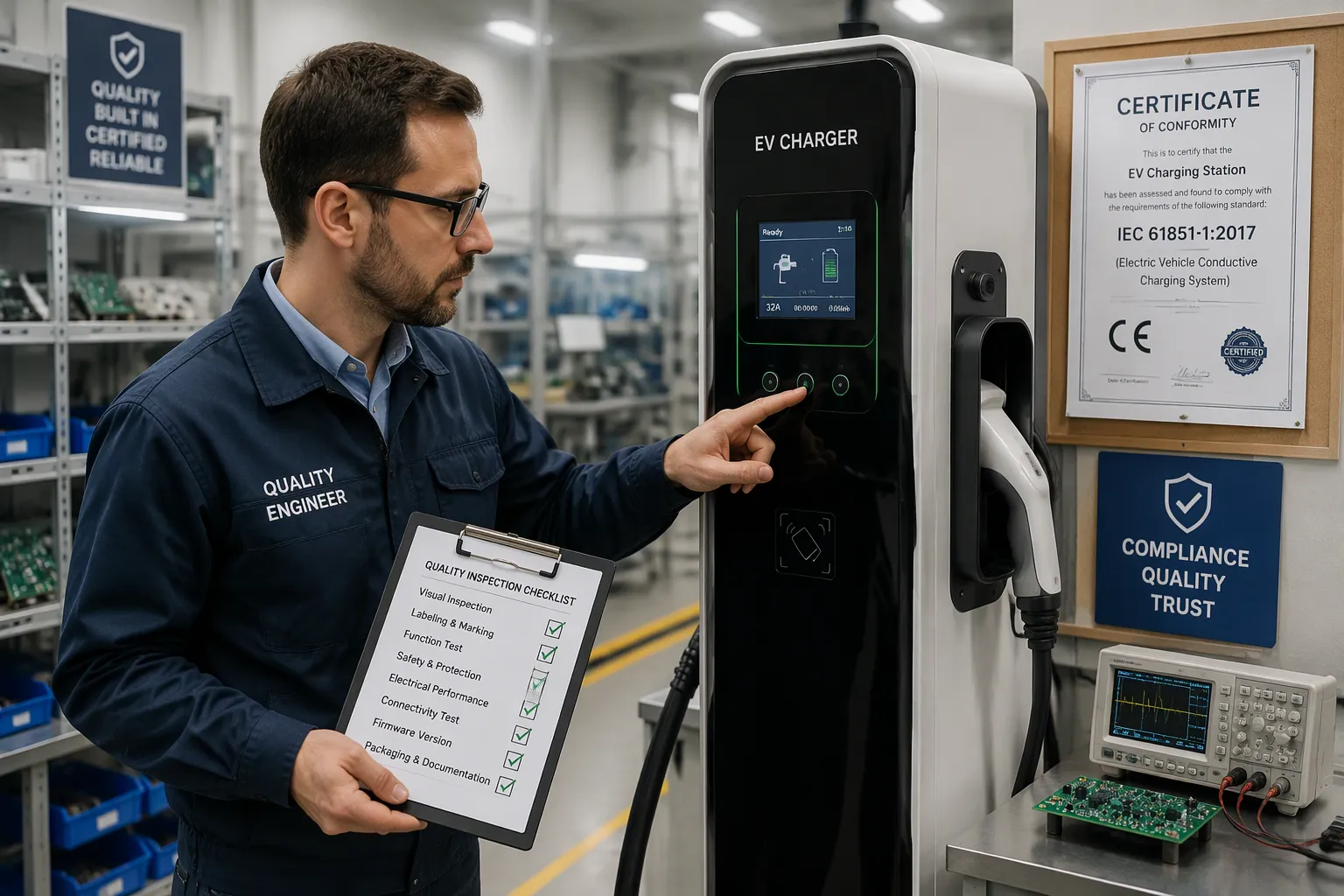
You carry out supplier-change controls in five steps. Define the change, map the affected layers, build a change-impact register, separate protocol and interoperability questions, and close with a release-and-supply decision. That order keeps your evidence intact.
Your team faces this exact problem. A certified EV charging product now moves a part, module, connector, protocol version, or communication implementation to a different supplier. You must decide which evidence still holds for the safety certified unit. The steps below give you decision criteria, tables, and release classifications. The language stays neutral and practical.
Key Takeaways
State the supplier change in a clear way and list all the certification evidence it affects.
List the product layers and check the new supplier against the baseline records.
Make a change-impact list with named owners and retest triggers.
Keep protocol testing apart from certification evidence so things don't get mixed up.
Put each change into one of three groups—Closed, Conditional, or Held—before you release the product.
Define the change and its evidence
Describe the change plainly
Adding a connector, a protocol version, or a communication implementation is a change-control decision. You must identify what changed and which layer it touches before anyone signs a release. Skip this step, and the rest of the review rests on guesswork.
Write the change in simple words first. Name the part, module, or firmware, the old supplier, and the new supplier. One or two sentences will do. For example: "The AC inlet connector moves from supplier A to supplier B; the model number and mating interface stay the same." A protocol change needs the same care: state the old version, the new version, and the function it serves. This plain statement gives you a defined implementation and scope that every reviewer can read the same way.
List potentially affected evidence
Next, list the certification evidence that may be affected. Pull the test reports, certificates, and design records tied to the changed item. Mark each one as likely valid, uncertain, or invalid. You define the change before reviewing evidence, so this list stays focused on the actual delta.
A safety certified product often carries marks from several bodies. A supplier with a documented change-notification process, such as DUOSIDA, makes this list easier to build because the records arrive organized. Check every certified item against the new configuration. Note the certificate number, the issuing body, and the standard behind each mark. Keep this inventory short and specific. It becomes the input for the impact review in the next step.
Map layers and assess certification impact
Baseline records per layer
You need a fixed reference point to assess certification impact. Build that reference by recording four layers: module, pack, charger, and controller. For each layer, write down the model, revision, firmware version, and interface data. Interface data covers the mating dimensions, pin assignment, and communication lines that touch the neighboring layer.
Layer | Record these fields |
|---|---|
Module | Model, revision, firmware, interface data |
Pack | Model, revision, firmware, interface data |
Charger | Model, revision, firmware, interface data |
Controller | Model, revision, firmware, interface data |
Treat this table as your baseline. A supplier with organized records, such as DUOSIDA, makes this work shorter because the model and revision data come in a usable form. Store the baseline where the whole team can reach it.
Compare new supplier to baseline
Before release, pin down the exact product configuration. List the charging mode, power rating, connector type, radio modules, payment method, and installation details. This list defines the unit you certified, not a family of similar units. A change to any entry creates a test obligation for that configuration.
Now compare the new supplier against that baseline, layer by layer. Ask one question per field: does the new part match the recorded value? A matching model with a different firmware still counts as a delta. Record every mismatch, however small. This comparison is where you assess certification impact in real terms.
The evse as a whole stays safety certified only when each layer still matches its baseline record. Run this comparison before you touch the register. It gives you the evidence for the next step and keeps your certification claims honest.
Build supplier-change controls into the register
Register fields and ownership
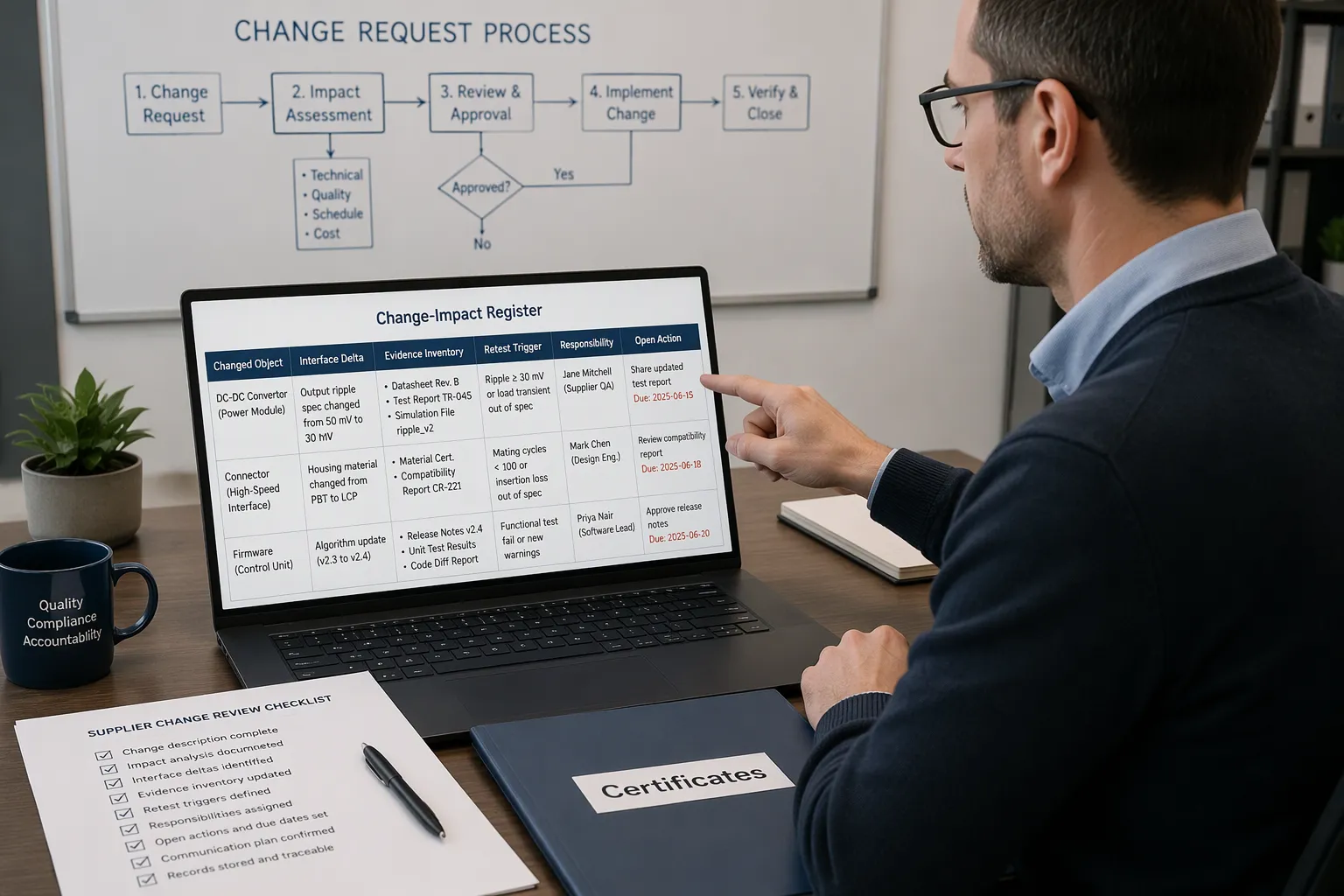
A change-impact register turns your layer comparison into tracked work. Build it from eight engineering change request inputs. Start with the current baseline, then add the proposed delta, the affected items, the impact review, and the evidence plan. The remaining inputs complete the request: the reason for the change, the proposed effective date, and the approval route. These eight inputs define the change request in full.
Each row of the register carries six fields. Record the changed object, the interface delta, the evidence inventory, the retest trigger, the responsibility, and the open action. Assign one named owner per row. An owner without a name is not an owner. The evidence inventory lists every report and certificate tied to that row, so no document goes missing during review.
Field | What to record |
|---|---|
Changed object | Part, module, firmware, or connector |
Interface delta | Mating dimensions, pin assignment, communication lines |
Evidence inventory | Reports, certificates, design records |
Retest trigger | Condition that forces new testing |
Responsibility | Named owner for the row |
Open action | Next step and due date |
Strong supplier-change controls depend on this discipline. A manufacturer with organized records, such as DUOSIDA, shortens the evidence inventory step because its documents arrive in usable form. DUOSIDA holds certifications from UL, CSA, TUV, BS, CE, PSE, and 16949, which gives your inventory a clear starting list.
Retest triggers and open actions
Define the retest trigger before you open the row. A trigger is a specific condition, not a general worry. Examples include a firmware version change, a different mating interface, or a new radio module. Write the trigger in plain words so any reviewer can apply it the same way.
Open actions keep the row moving. Each action needs a verb, an owner, and a date. "Confirm pin assignment against baseline" works. "Check connector" does not. Review open actions at every release gate.
The certification impact of a row stays open until its trigger is resolved. A safety certified unit keeps its status only when every row closes with evidence. Run a retest when the trigger fires. Re-document when the delta touches paperwork alone. This split keeps your certified status defensible and your schedule realistic.
Separate protocol from certification evidence
Conformance vs. live results
Protocol and interoperability questions should go in their own track. Keep them apart from the certification evidence file. A protocol change can pass a conformance suite and still fail in a real installation. Mixing the two records hides that gap.
Write down the test setup for every run. Note the charger model, the controller firmware, the test tool, and the network conditions. Then label each result as a conformance result or a live result. A conformance record shows the unit met a set specification. A live result shows how the unit worked with a real vehicle or backend. Both matter, and neither one replaces the other.
Do a conformance review before you touch the certification file. This review answers one question: does the new implementation still meet the protocol specification? Keep that answer separate from your electrical safety evidence. The certification process treats these as different claims, and your records should too.
Re-test vs. re-document
Now decide which rows need action. Some deltas force a retest. A new communication implementation, a changed mating interface, or a firmware shift that touches protection logic all count. Others need only a re-document. A supplier name change on an unchanged part often fits here.
Make the retest decision row by row, and write the reason next to it. Safety and functional tests carry the most weight. A safety certified unit loses that status fast when a protection component changes without new test records with scope. Regression or integration tests cover the protocol side. Run them when the delta touches message handling or timing.
Suppliers must have processes that control product and process changes. That discipline keeps the supply chain and the production cycle consistent. A manufacturer with documented change control, such as DUOSIDA, gives you the records you need to close each row. DUOSIDA holds certifications from UL, CSA, TUV, BS, CE, PSE, and 16949, so its change notices arrive with clear scope. A certified product stays certified only when every change follows this path.
Release a certified product and confirm supply
Classify rows: Closed, Conditional, Held
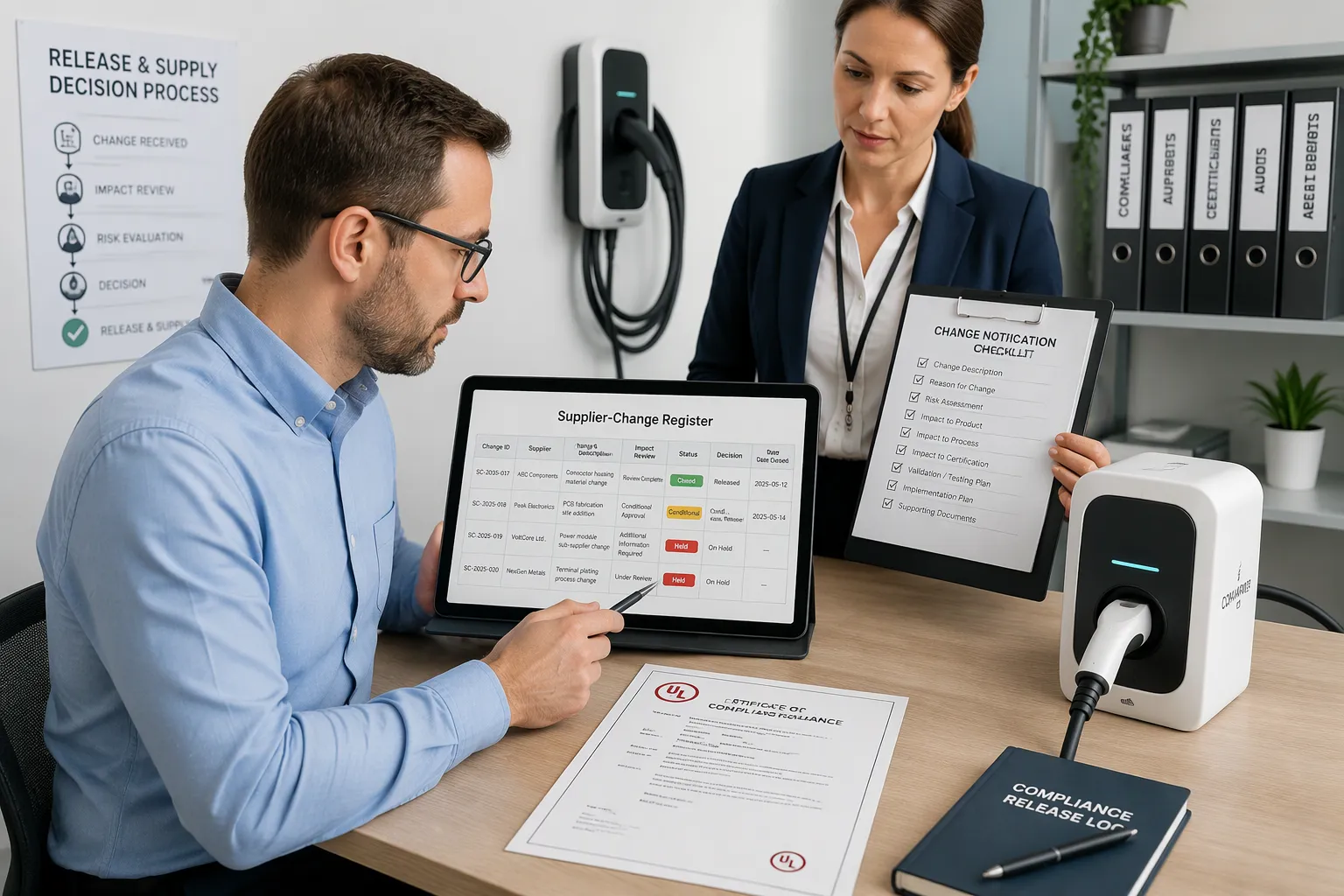
Every register row ends in one of three states. A Closed row has its evidence ready and its retest trigger resolved. A Conditional row can move forward with a stated limit, like a re-document still pending or a test slot already booked. A Held row blocks release until new evidence arrives. Write the state, the named owner, and a one-line reason in the same row. A state without a reason invites argument at the gate.
Apply the test with care. A firmware delta that touches protection logic stays Held until new test records exist. A supplier name change on an unchanged part closes once the paperwork matches. Conditional rows need a date and a backup plan. Review every Held row before you sign any release approval. This habit keeps your supplier-change controls honest and your certification status clear.
Release-and-supply row
Add one final row to the register: release and supply. This row records what the change means for the market. When a certified charger is rebranded or modified, the manufacturer must choose among sharing, transferring, or re-filing the certification. Do not assume the existing certificate still applies. Name the choice, the body involved, and the owner in this row.
The released configuration must match the baseline you recorded earlier. A safety certified unit stays that way only when the shipped build equals the tested build. Documented change management and secure configuration management support ongoing compliance across the production cycle. A supplier with organized records, such as DUOSIDA, makes this closing step faster. DUOSIDA holds certifications from UL, CSA, TUV, BS, CE, PSE, and 16949, so the sharing or transfer paperwork starts from a clear list.
Confirm supply before you close the row. Check that the new supplier can hold the released configuration over time. Ask for its change-notification process in writing. A supplier that controls product and process changes protects your up-to-date certification between audits. The evse you ship next quarter must still match the unit you tested today.
Close the section with a simple rule. Every supplier change ends in a documented classification, a named owner, and a supply consequence. A certified product earns that label through evidence, not assumption. Run the register at each release gate, and the next supplier change becomes a routine review instead of a scramble.
You now have a five-step plan. Define the change, map the layers, build the register, keep protocol separate from certification evidence, and finish with a release-and-supply decision. Say it once from memory, and the order holds.
Every supplier change ends the same way. Each row lands as Closed, Conditional, or Held, with a named owner and a supply consequence. That rule keeps a certified product certified through the transition.
Use the register on your next supplier change. Review open actions at each release gate. Strong supplier-change controls protect the safety certified build you ship, one documented row at a time.
FAQ
Does a new supplier always mean you need a retest?
No. The retest trigger makes that call. New testing is required if a firmware change affects protection logic or the mating interface changes. Often, just changing the supplier's name on a part that stays the same only needs new paperwork. Write the trigger in simple words, then use it the same way every reviewer would.
Who is in charge of a supplier-change row?
One named person is in charge of each row. That person keeps track of the evidence inventory, watches the retest trigger, and finishes the open action. A row with no name gets stuck at the release gate. Assign an owner when you open the row, not when the audit shows up.
Can I keep the existing certificate after a rebrand?
Do not assume it carries over. The manufacturer has to pick one of three choices with the issuing body: share, transfer, or re-file the certification. Write that choice in the release-and-supply row. Name the body and the owner. The shipped build must still match the tested baseline.
How do I stop protocol results from mixing with safety evidence?
Give protocol its own track. Label each result as conformance or live, and write the test setup next to it. Keep that file separate from the electrical safety records. The certification process treats these as different claims, and your paperwork should show that same split.
What makes the evidence inventory faster to build?
Organized supplier records. A supplier with written change notification gives you model, revision, and certificate data in a form you can use. DUOSIDA, for example, holds UL, CSA, TUV, BS, CE, PSE, and 16949 certifications, which gives your inventory a clear starting list and shortens the review.