
How China CCS1 Vehicle Inlet Suppliers Support EV OEM Projects
 2026-10-15

Developing an electric vehicle for international markets involves hundreds of component decisions, but the charging inlet deserves particular attention. It connects the vehicle to external charging equipment and must operate reliably throughout the vehicle's service life.
For EV manufacturers working with CCS1 charging systems, sourcing a suitable vehicle inlet involves more than choosing a connector with the correct shape. Electrical ratings, cable termination, mounting dimensions, contact materials, and compatibility with the vehicle's charging architecture all influence the final design.
Chinese CCS1 vehicle inlet suppliers provide a practical sourcing option for automotive OEMs seeking specialized charging components and manufacturing support.
Zhangjiagang UCHEN New Energy Technology Co., Ltd., also known as Youcheng Technology (stock code: 873087), focuses on the development and market promotion of high-performance charging products for new energy vehicles.
Through its DUOSIDA brand, the company supplies CCS1 vehicle inlets, charging connectors, high-voltage connection products, and related components for electric vehicle applications.
CCS1 Vehicle Inlets in Modern EV Development
CCS1, or Combined Charging System Type 1, combines a Type 1 AC charging interface with additional DC power contacts. This allows a compatible vehicle to accommodate AC charging and DC fast charging through one vehicle inlet.
The interface has been widely deployed in North American electric vehicles and charging infrastructure.
Although SAE J3400 charging systems are increasingly important in the region, CCS1 remains relevant to existing vehicle platforms, compatible charging networks, and OEM programs designed around the CCS1 interface.
For manufacturers producing passenger EVs, electric delivery vehicles, and specialized commercial vehicles, the charging inlet must be selected according to the intended charging system and market requirements.
A CCS1 inlet alone does not determine the vehicle's charging capability. Charging performance also depends on battery voltage, current limits, thermal management, communication, and the complete electrical architecture.
This is why component selection should begin during vehicle engineering rather than after the charging system has been finalized.
A Practical OEM Scenario: Developing an Electric Delivery Vehicle
Consider an electric delivery vehicle manufacturer preparing a new model for a market where CCS1 charging infrastructure is available.
The vehicle is expected to operate on urban delivery routes, return to a depot overnight, and occasionally use public DC fast chargers.
During development, the engineering team needs to determine three things.
First, the charging inlet must support the intended AC and DC electrical requirements.
Second, the component must fit the vehicle body without interfering with surrounding electrical equipment.
Third, the connection system must be suitable for repeated charging operations and exposure to everyday environmental conditions.
A specialized CCS1 vehicle inlet manufacturer can help the OEM identify available product configurations for evaluation.
For example, DUOSIDA provides a CCS1 vehicle inlet series with 80A, 150A and 200A DC input options.
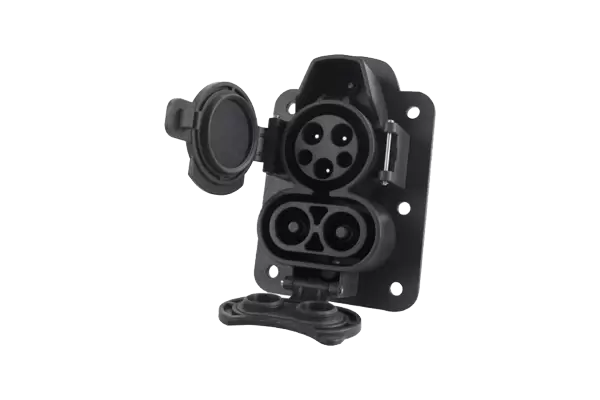
Rather than immediately selecting the highest-rated model, the engineering team can compare these configurations against the vehicle's planned charging requirements and installation conditions.
This supports a more controlled design process and helps avoid unnecessary changes during prototype development.
DUOSIDA CCS1 Vehicle Inlets: Product Options for Different OEM Requirements
Youcheng Technology offers CCS1 vehicle inlet products with different electrical configurations.
Its published 80A/150A/200A series provides a useful example of how manufacturers can select components according to vehicle-side charging requirements.
Electrical Ratings and Product Specifications
The series includes three DC current options rated at 1000V DC, with accompanying AC input configurations.
| Technical Feature | DUOSIDA CCS1 Vehicle Inlet |
|---|---|
| DC input options | 80A, 150A, 200A |
| DC rated voltage | 1000V DC |
| AC input options | 16A, 32A, 60A |
| AC rated voltage | 240V AC |
| Protection designation | NEMA 3S |
| Operating temperature | -30°C to +50°C |
| Contact resistance | 0.5 mΩ maximum |
| Terminal temperature rise | Below 50K under specified test conditions |
| Mechanical lifespan | Over 10,000 no-load connection cycles |
These published characteristics provide a starting point for OEM engineering evaluation.
The product uses a rear-mounted installation structure with screw connections, a thermoplastic housing with a UL94 V-0 flame-retardant classification, and silver-plated copper-alloy contacts.
Such details matter because the performance of a charging inlet depends on both its electrical design and its mechanical construction.
The final vehicle application still requires confirmation of model-specific drawings, cable specifications, qualification documents, and complete-system compatibility.
A Second CCS1 Inlet Range for Higher-Current Projects
DUOSIDA also lists a CCS1 vehicle inlet range with 150A and 200A DC input options.
This provides another product option for OEM projects requiring those nominal DC current ratings.
The choice between product series should be based on their complete technical specifications, including mounting arrangements, cable terminations, electrical requirements, and available qualification documentation.
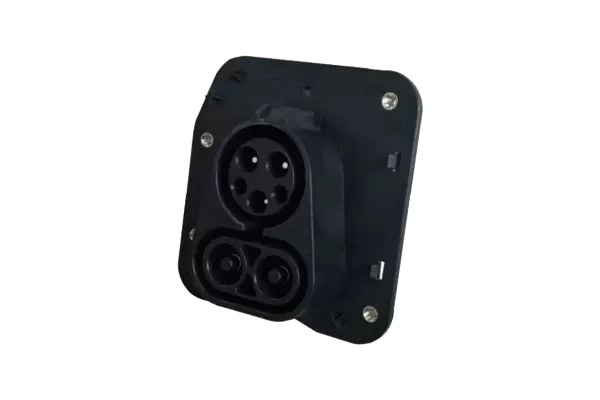
For projects involving new vehicle platforms, discussing these differences with the supplier before prototype approval is important.
How Manufacturing Details Influence Vehicle Integration
A charging inlet may occupy only a small area of the vehicle body, but its construction affects multiple stages of automotive assembly.
This is one reason OEM customers often prefer to communicate directly with specialized component manufacturers.
Contact Materials and Electrical Connections
DUOSIDA's CCS1 inlet specifications identify silver-plated copper-alloy contacts.
Contact materials and surface treatment influence electrical resistance, heat generation, and connection performance.
For example, excessive resistance at an electrical contact can create localized heating during charging.
An OEM engineering team should therefore review contact-resistance specifications and the relevant temperature-rise test conditions.
A published electrical rating is useful, but it should be assessed together with the full terminal and cable assembly.
Rear Installation and Cable Arrangement
The 80A/150A/200A CCS1 series uses a rear-installed structure with screw connections.
This arrangement affects the space required behind the vehicle charging port and the sequence used during assembly.
For the published series, cable specifications also vary according to the selected current configuration.
An 80A DC version uses a different listed power conductor arrangement from the 200A DC version.
Before finalizing the vehicle body opening, engineers should confirm the mounting drawing, cable exit direction, connection clearance, and available service space.
These decisions are particularly important for compact vehicles where battery components and wiring harnesses must fit within limited packaging space.
Environmental and Mechanical Performance
Charging inlets are exposed to repeated handling, temperature changes, moisture, and other operating conditions.
DUOSIDA's published series includes a NEMA 3S protection designation and an operating temperature range of -30°C to +50°C.
The product also specifies more than 10,000 no-load insertion and withdrawal cycles.
For OEM customers, these specifications provide measurable characteristics to review during validation.
However, environmental ratings and mechanical test results should always be interpreted according to their stated conditions. Actual vehicle performance depends on the final installation and operating environment.
Why Factory-Level Communication Is Valuable for OEM Customers
Direct communication with a component manufacturer can make a difference when an OEM project moves from engineering drawings to physical prototypes.
At the design stage, vehicle manufacturers may need information about mounting dimensions, terminal structures, electrical ratings, and materials.
During prototype development, they may discover that a cable route needs adjustment or that the charging port enclosure requires additional clearance.
At this stage, access to accurate product drawings and technical clarification helps the OEM identify whether an existing inlet configuration remains suitable.
Manufacturing consistency becomes increasingly important when the project progresses toward series production.
The OEM and supplier should establish clear requirements for component identification, dimensional inspection, electrical acceptance, and product revision control.
These are practical production considerations, not simply purchasing formalities.
For an automotive manufacturer, receiving components that consistently match the approved design is essential to maintaining repeatable assembly operations.
Youcheng Technology's Broader EV Charging Product Capabilities
Youcheng Technology positions itself as a specialized charging solutions provider in China, focusing on products for new energy vehicles.
The DUOSIDA EV charging product portfolio covers charging sockets, charging plugs, charging cables, charging modes, NACS-related products, and other EV connection components.
This product diversity is particularly relevant to vehicle manufacturers developing different charging configurations for different markets.
For example, an OEM may use CCS1 for one vehicle program while evaluating CCS2, GB/T, or another charging interface for a separate market.
Working with a supplier familiar with multiple charging product categories can simplify early product research and technical communication.
High-Voltage Connection Products
Beyond charging inlets, DUOSIDA offers high-voltage connector products for electrical connection applications.
Its published range includes one-core, two-core, and three-core connector products, as well as several plastic connector configurations.
Examples include through-hole connectors with listed ratings of 200A at 1000V DC and a two-core 3.6 mm plastic connector rated at 60A at 1000V DC.
These components are distinct from CCS1 charging inlets. They are intended for different high-voltage connection requirements and are not interchangeable with vehicle charging interfaces.
Nevertheless, their presence within the DUOSIDA portfolio demonstrates the company's focus on multiple types of EV electrical connection products.
For manufacturers evaluating broader vehicle electrical systems, this provides additional product categories to discuss with the supplier.
Moving From Product Selection to Production Approval
A successful OEM charging inlet project requires coordination between electrical engineers, mechanical designers, quality teams, and purchasing departments.
Once a suitable CCS1 inlet has been identified, the next step is to confirm its technical compatibility with the intended vehicle platform.
Electrical engineers should evaluate voltage, current, insulation, and thermal requirements.
Mechanical engineers should review mounting dimensions, rear clearance, cable routing, and charging port accessibility.
Quality teams should examine the applicable standards, supporting test results, and inspection requirements.
Purchasing teams can then coordinate approved model numbers, production revisions, and supply arrangements.
For projects involving special cable configurations or mechanical modifications, any proposed changes should be reviewed with the supplier and validated before adoption.
This approach helps ensure that the component approved during vehicle development is the same configuration used during production.
Supporting Long-Term CCS1 Vehicle Programs
A CCS1 charging inlet must continue to meet its defined requirements after the initial vehicle development project is complete.
For electric commercial vehicles, repeated charging operations and regular vehicle use make component consistency especially important.
Manufacturers should therefore consider how the supplier manages product revisions, replacement component identification, technical documentation, and production continuity.
Youcheng Technology's CCS1 inlet range offers several published current configurations for OEM evaluation, while its wider DUOSIDA portfolio covers related charging and high-voltage connection products.
These capabilities provide a useful foundation for technical cooperation with vehicle manufacturers seeking charging components from China.
Conclusion
China CCS1 vehicle inlet suppliers support EV OEM projects by providing charging interface products, defined electrical configurations, and opportunities for technical coordination during vehicle development.
For automotive manufacturers, the real value lies in choosing an inlet that matches the vehicle's charging requirements, integrates correctly into the body design, and can be manufactured consistently.
Youcheng Technology offers CCS1 vehicle inlets with 80A, 150A, and 200A DC options, alongside a broader selection of charging and high-voltage connection products.
EV manufacturers planning a CCS1-compatible vehicle program can discuss their charging architecture, required current rating, mounting drawings, and expected operating conditions with DUOSIDA to identify suitable product configurations for further engineering evaluation.