
China Type 1 AC Vehicle Inlet Factory: Quality and Production
 2026-10-15

A Type 1 AC vehicle inlet is a relatively small component, but its manufacturing quality can influence the reliability of an entire electric vehicle charging system. From terminal conductivity to housing strength and assembly accuracy, every detail matters when the inlet is installed on a vehicle and used repeatedly.
For electric vehicle manufacturers sourcing charging components from China, factory specialization and product consistency are important considerations. A suitable supplier should offer more than a standard connector. It should understand the electrical, mechanical, and production requirements associated with automotive charging interfaces.
Zhangjiagang UCHEN New Energy Technology Co., Ltd., also known as Youcheng Technology (stock code: 873087), focuses on the development and market promotion of high-performance charging products for new energy vehicles.
Through its DUOSIDA brand, the company provides Type 1 AC vehicle inlets, charging connectors, charging cables, and related electrical connection products.
Its Type 1 inlet range illustrates how different current ratings, mounting structures, and material specifications can address the requirements of different electric vehicle platforms.
Manufacturing Quality Starts With the Inlet Design
Type 1 AC vehicle inlets are based on the SAE J1772 charging interface, which is associated with single-phase AC charging.
The inlet is installed on the vehicle and connects to compatible external charging equipment. Unlike CCS1 combined charging inlets, a standalone Type 1 AC inlet does not incorporate the additional DC contacts used for CCS fast charging.
Its construction involves several important elements: a connector housing, conductive terminals, insulation structures, mechanical mounting features, and cable connections.
During product development, each element must be considered in relation to the complete vehicle charging system.
For instance, the terminal arrangement must provide reliable electrical contact, while the housing must support installation and protect internal components. The mounting structure must also fit the vehicle body and allow appropriate cable routing.
For a manufacturer, the objective is not simply to produce a connector that meets its nominal dimensions. The component must also maintain its specified characteristics across repeat production batches.
This is where material selection, assembly accuracy, and clearly defined inspection requirements become particularly valuable.
Two DUOSIDA Type 1 AC Vehicle Inlet Configurations
Youcheng Technology offers Type 1 AC vehicle inlet products with different electrical ratings and installation arrangements.
Two published configurations demonstrate how product design can respond to different automotive requirements.
Rear-Mounted Type 1 AC Vehicle Inlet: 16A and 32A
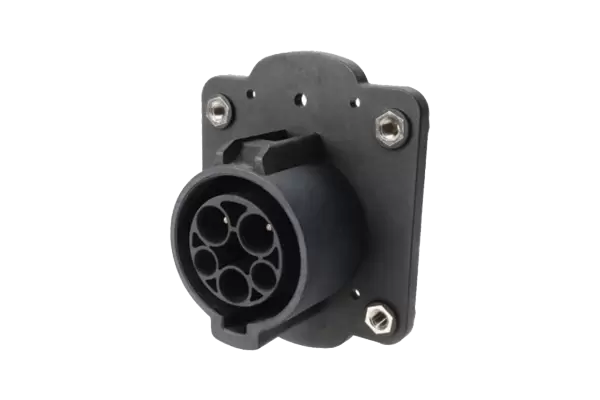
The DUOSIDA Type 1 AC Vehicle Inlet with 16A and 32A current options features a rear-mounted installation structure.
Its published specifications include an IP54 protection rating, a tail protection designation of IPX7, and an operating temperature range from -30°C to +50°C.
The product uses a thermoplastic housing with a UL94 V-0 flame-retardant classification and silver-plated copper-alloy terminals.
Its listed cable configurations are:
| Model | Rated Current | Standard Cable Specification |
|---|---|---|
| V5-DSS-G-EV16S | 16A | 3 × 14 AWG + 2 × 22 AWG |
| V5-DSS-G-EV32S | 32A | 3 × 10 AWG + 2 × 22 AWG |
The rear-mounted design is relevant for vehicle manufacturers planning the charging port position and installation sequence.
Engineers need to consider the available space behind the vehicle body panel, the terminal connection arrangement, and the clearance required for wiring.
This configuration offers two current options for different AC charging requirements, subject to the vehicle's onboard charging system and complete electrical design.
Front-Mounted Type 1 AC Vehicle Inlet: 16A to 50A
The DUOSIDA Type 1 AC Vehicle Inlet with 16A, 32A, 40A and 50A options provides a different mechanical arrangement.
This series features front-mounted installation and a clamshell protective cover.
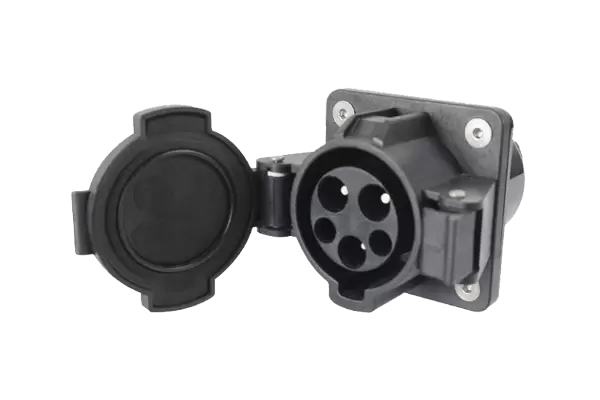
Its published specifications include a 240V operating voltage, IP54 protection under the stated working condition, and an operating temperature range of -30°C to +50°C.
The product also uses silver-plated copper-alloy contacts and a thermoplastic housing with a UL94 V-0 flame-retardant classification.
The current ratings and cable specifications vary by model:
| Model | Rated Current | Standard Cable Specification |
|---|---|---|
| V3-DSS-G-EV16S | 16A | 3 × 14 AWG + 2 × 18 AWG |
| V3-DSS-G-EV32S | 32A | 3 × 10 AWG + 2 × 18 AWG |
| V3-DSS-G-EV40S | 40A | 2 × 8 AWG + 1 × 10 AWG + 2 × 18 AWG |
| V3-DSS-G-EV50S | 50A | 2 × 8 AWG + 1 × 10 AWG + 2 × 18 AWG |
For vehicle designers, the front-mounted structure and protective cover may offer a suitable arrangement for charging port designs requiring access from the exterior panel.
The availability of 40A and 50A configurations also provides additional options for vehicle platforms with corresponding AC charging requirements.
However, selecting a higher-rated inlet does not automatically increase charging speed. The onboard charger, charging equipment, wiring, and vehicle control system determine the actual charging current.
Material Selection and Its Impact on Product Reliability
The materials used in a vehicle inlet directly influence its electrical and mechanical characteristics.
DUOSIDA's published Type 1 inlet specifications identify copper-alloy conductive components with silver-plated contact surfaces.
Copper alloys are commonly used in electrical connector applications because of their conductive and mechanical properties. Silver plating helps provide an electrically conductive contact surface.
For charging inlet manufacturing, contact performance is particularly important because electrical resistance can contribute to heat generation during charging.
Both DUOSIDA Type 1 product series publish a maximum contact resistance of 0.5 mΩ and a terminal temperature-rise specification below 50K under the stated test conditions.
These measurable parameters give vehicle manufacturers a basis for reviewing electrical performance.
The housing material is equally important.
The published thermoplastic housing classification of UL94 V-0 relates to the material's performance in a standardized flammability test. It does not, by itself, establish the safety of the complete vehicle charging system.
Manufacturers should evaluate material specifications together with mechanical construction, insulation performance, and application requirements.
Precision Assembly and Production Consistency
For automotive applications, the same inlet design may be installed across thousands of vehicles.
This makes manufacturing consistency an important part of product quality.
Several production characteristics require particular attention.
Terminal positioning: Conductive contacts must remain within the specified dimensional tolerances to support proper engagement with compatible charging connectors.
Housing assembly: Insulating and structural components must be positioned correctly to maintain the intended mechanical alignment and protection.
Cable termination: Power and signal conductors must be connected according to the approved model configuration and assembly requirements.
Mounting accuracy: Front-mounted and rear-mounted products require appropriate dimensional control so they can be installed consistently in vehicle body structures.
A factory's production quality should be evaluated through documented processes, inspection criteria, and sample verification.
For OEM customers, it is useful to confirm how critical dimensions, cable connections, and product revisions are controlled before approving a component for serial production.
Product Testing: More Than a Rated Current
A vehicle inlet must withstand electrical loading and repeated mechanical connection.
DUOSIDA publishes several measurable performance characteristics for its Type 1 AC vehicle inlet products.
Both product series specify:
Insulation resistance greater than 100 MΩ when tested at 1000V DC for one minute.
Withstand voltage of 2500V AC for one minute.
Terminal temperature rise below 50K under specified test conditions.
Contact resistance of 0.5 mΩ maximum.
More than 10,000 no-load insertion and withdrawal cycles.
Coupled insertion force below 100N.
These figures are useful during the component evaluation process because they describe specific electrical and mechanical characteristics.
For instance, insulation testing helps assess electrical separation, while temperature-rise measurements provide information about thermal behavior under defined conditions.
Mechanical cycling evaluates repeated connection performance, although the published no-load cycle rating should not be interpreted as an unconditional service-life guarantee.
Product qualification should also consider applicable SAE J1772 and UL 2251 requirements, including the specific editions and verification evidence relevant to the intended market.
Supporting Vehicle Assembly and OEM Production
A Type 1 AC vehicle inlet must fit the intended vehicle architecture.
For a compact passenger EV, the charging port may be located behind a small exterior flap. Space for rear wiring can be limited, making mounting dimensions and cable exit arrangements important.
A commercial vehicle may use a larger charging compartment with different accessibility requirements.
In both situations, the engineering team must verify that the chosen inlet can be installed without interfering with surrounding components.
DUOSIDA's front-mounted and rear-mounted Type 1 inlet configurations provide different mechanical options for evaluation.
During an OEM project, vehicle manufacturers should review drawings, installation space, cable specifications, and the approved electrical configuration before finalizing the body design.
The production team should then establish consistent assembly instructions and inspection requirements for the selected component.
These steps are particularly important when the vehicle manufacturer is moving from prototype assembly to regular production.
Youcheng Technology's Wider Charging Product Portfolio
Youcheng Technology focuses on charging products and connection solutions for new energy vehicles.
Through the DUOSIDA EV charging products portfolio, customers can explore charging sockets, charging plugs, charging cables, charging equipment, and components for different charging standards.
For vehicle manufacturers developing multiple models or serving different markets, this wider product coverage offers additional component options.
DUOSIDA also supplies high-voltage connector products for other electrical connection applications.
The high-voltage connector category includes different one-core, two-core, and three-core connector configurations.
These products are distinct from Type 1 AC charging inlets and serve different electrical functions. However, they demonstrate the broader range of EV connection components available through the DUOSIDA portfolio.
For engineering and purchasing teams, this provides an opportunity to discuss several related component categories with one specialized charging products provider.
What International OEM Customers Should Confirm
Factory specialization is valuable, but a production project still requires clear technical and quality requirements.
Before approving a Type 1 AC vehicle inlet, international customers should confirm the exact model designation, electrical ratings, dimensional drawings, cable specifications, and installation instructions.
The discussion should also cover relevant test documentation, environmental protection conditions, and inspection requirements.
For long-term supply, product revision control and consistent component identification are equally important.
These arrangements help ensure that production components continue to match the configuration approved during vehicle development.
Conclusion
Manufacturing quality in Type 1 AC vehicle inlets depends on reliable materials, accurate component assembly, defined electrical performance, and consistent production requirements.
Youcheng Technology's DUOSIDA product range includes 16A and 32A rear-mounted Type 1 AC vehicle inlets, alongside front-mounted configurations offering 16A, 32A, 40A, and 50A options.
Their published features include silver-plated copper-alloy contacts, flame-retardant thermoplastic housings, documented electrical characteristics, and mechanical durability specifications.
For electric vehicle manufacturers seeking a Type 1 AC vehicle inlet supplier in China, these product options provide a practical starting point for evaluating charging interface requirements.
By matching the inlet's design and specifications to the vehicle platform, OEM customers can make better-informed component decisions and establish clearer technical requirements for production.
Manufacturers can contact DUOSIDA with their vehicle charging specifications, installation drawings, and expected application to discuss suitable Type 1 AC vehicle inlet configurations.