
Charging Solutions for Nordic Markets and How They Keep Cables Flexible in 2026
 2026-10-28

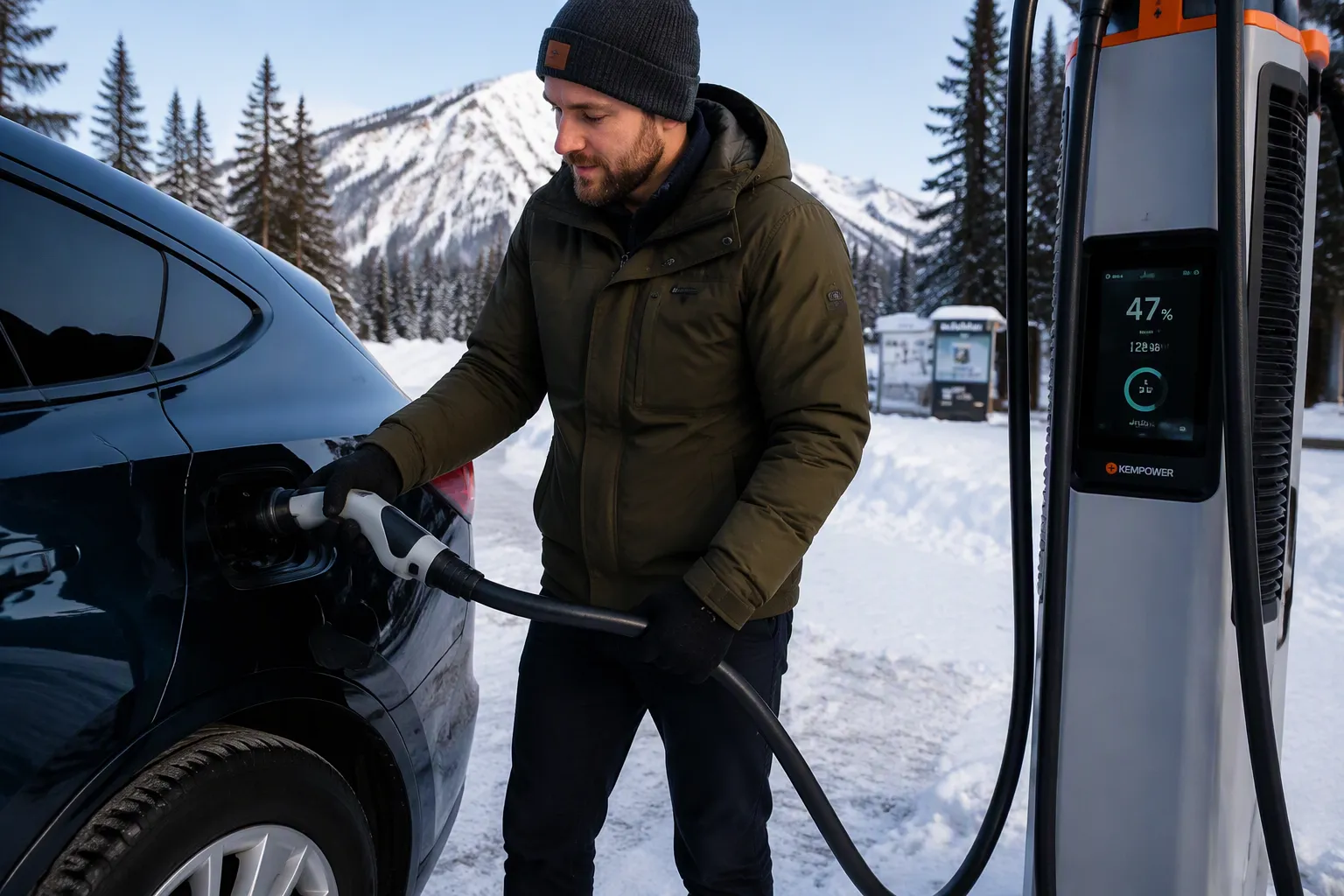
A charging cable works fine at 5°C. Then a Nordic cold snap hits, and that same cable turns stiff, kinked, and hard to coil. Drivers notice the problem fast, and they want to know what actually fixes it in 2026.
The core question is simple: which materials, ratings, and sealing designs keep a charging cable flexible and its connectors reliable at -30°C and below? Cold weather shows weak jacket compounds and poor seals without mercy.
This post explains the technical challenges behind cold stiffness, the features that protect cable flexibility, and the charging solutions for Nordic markets that hold up in real winter conditions.
Key Takeaways
Pick TPU or silicone covers for very cold weather. These materials stay bendy at -40°C and even lower.
Check the cold-bend test results. A cable rated for -40°C may still be hard to coil, so ask for the test data.
Pair IP ratings with temperature ratings. IP67 by itself does not promise it will work in winter.
Set up chargers that are IP67 and IK10 rated. Add a canopy and extra units to handle winter demand.
Store cables in loose loops and keep the connectors clean. Handling them gently stops cracks and helps cables last longer.
Why EV Charger Cables Get Stiff in Cold Weather
Material Embrittlement and Stiffness
The jacket material controls how an ev charger cable stiff in cold weather acts. Regular PVC begins to harden at about −10°C. By −25°C it is basically rigid, and below −15°C it is not practical to use. When a driver coils this kind of cable in a Nordic cold snap, they are fighting the plastic itself, not the connector.
Better materials keep cable flexibility at much lower temperatures. Polyether TPU stays flexible down to −50°C and only turns brittle near −70°C. High-quality TPE holds up to −40°C, but it feels stiffer than TPU in extreme cold weather. Silicone keeps working across a glass transition range of −60°C to −100°C, which is why it is used in Nordic and industrial-grade EVSEs. Cold-rated jackets bend and coil freely at −32°C, and qualified cold-proof cables work from −40°C to +50°C.
Material | Stiffening Threshold | Glass Transition |
|---|---|---|
PVC | Stiffer from about −10°C; impractical below −15°C | −20°C to −40°C |
TPU | Flexible through typical winter conditions | −50°C to −60°C |
Silicone | Functional in extreme cold | −60°C to −100°C |
Ice, Moisture, and Seal Failure
Moisture gets into connectors through a slow daily cycle. Extreme cold makes plastics brittle and hardens gaskets, so they seal less well. Condensation builds up inside enclosures and freezes overnight. Daytime thawing then makes liquid water that drips onto electronics. The cycle repeats, and each round wears the seals down a little more.
Repeated freezing and melting cycles slowly wear down the small seals around the connector housing, which weakens their integrity over time.
That is why products in Northern Europe, Canada, and parts of the U.S. increasingly need IP66–IP67 certification. That rating shows seal integrity under repeated freezing and thawing. The mechanical durability of the cable jacket and the seal together decide whether a connector lasts several winters or fails in the first.
What Cold-Weather Flexibility Means in 2026
Low-Temperature Ratings and Cold-Bend Performance
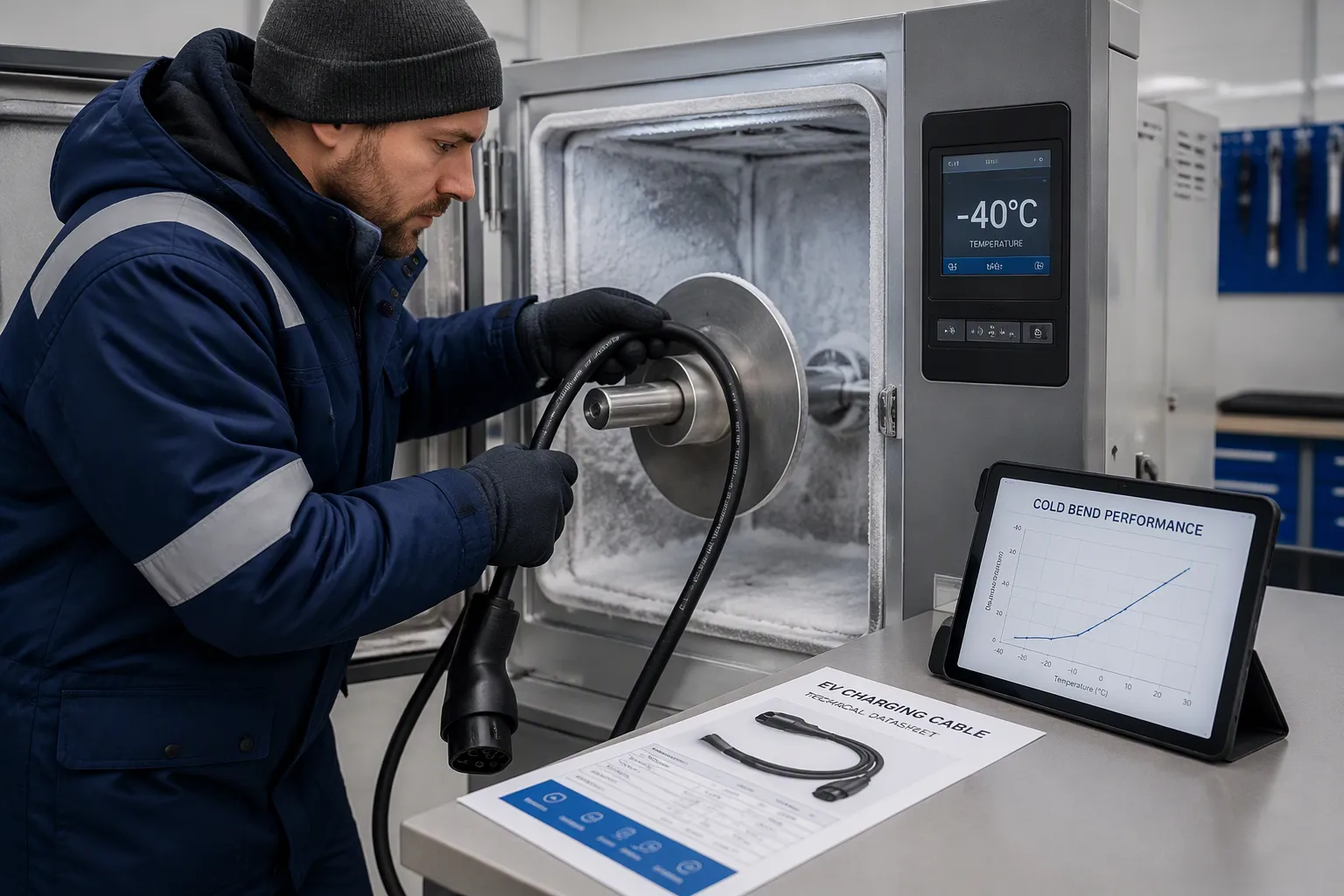
A temperature rating on a datasheet only tells part of the story. The real test in 2026 is cold-bend performance. This means how a cable acts when a technician or driver bends and coils it outdoors. Labs test this using cold-bend methods from standards like IEC 62893 and EN 50620 for EV charging cables. A sample sits in a climate chamber for hours, then wraps around a mandrel at the rated temperature. Cracks, jacket splitting, or exposed conductor mean a fail. A passing result at −40°C tells a buyer much more than a printed number alone. Cold-bend data makes cable flexibility something you can measure.
Jacket material | Practical cold behavior |
|---|---|
PVC | Stiff from about −10°C; impractical below −15°C |
TPE | Holds to −40°C; feels stiffer than TPU in deep cold |
Polyether TPU | Stays pliable to −50°C; brittle near −70°C |
Silicone | Works across a −60°C to −100°C glass transition range |
Wide operating ranges matter just as much. A cable rated from −40°C to +50°C covers Nordic winters and warm summer days in one product. Buyers should read the minimum operating temperature as a working limit, not a survival limit. A jacket that survives −40°C without cracking may still resist coiling at that temperature. Cold-rated jackets that bend freely at −32°C give a more honest picture of daily use. The gap between "does not break" and "still coils easily" separates an adequate cable from a good one.
EV Charging Cables for Cold Climates
Year-round reliability is the real goal. A cable that handles a winter storm must also survive a summer heatwave. Sun exposure, high ambient heat, and repeated flexing all age the cable jacket. Heat speeds up jacket hardening, and a hardened jacket loses low-temperature flexibility by the next winter. UV-stable compounds and wide thermal ranges protect both ends of the year. A site that swings from −30°C in February to +35°C in July needs a rated window with margin on both sides.
Summer heat deserves equal attention. A jacket that softens in high heat can deform where it hangs over a hook or rests on hot pavement. Repeated heat aging also hardens the compound over time. A cable that passes a cold-bend test when new may fail it after two summers of UV exposure. Buyers should ask for aging data, not just a fresh-sample result. Shade and cable management help, but material choice decides the outcome.
Verification takes three questions. Which standard did the lab follow? At what temperature did the sample bend? Did the test cover the full assembly, including the connector? A supplier who answers all three gives a buyer something to check. A supplier who answers none leaves the buyer guessing.
The best ev charging cables for cold climates combine three traits. First, a jacket compound with proven low-temperature performance, such as polyether TPU, silicone, or a cold-rated TPE. Second, documented low-temperature bending results from a named test standard. Third, mechanical durability that holds up through thousands of flex cycles across seasons. Buyers who compare these three traits side by side get a cable that stays flexible in cold weather and in heat. That combination defines cold-weather flexibility in 2026: a measured, documented property rather than a marketing phrase.
Sealing and Connector Reliability in Ice
IP Protection and Moisture Ingress
An IP rating shows a buyer how well a connector keeps out dust and water in set test conditions. It does not tell the full winter story. Snow and sleet fall under NEMA Type 3R, not under IP66 or IP67. IP66 covers strong water jets, which matters for driving rain and hose spray. IP67 adds short immersion at 1 meter. Neither rating clearly states snow or sleet protection.
Rating | Tested against | Practical meaning |
|---|---|---|
IP54 | Splashing water from any direction | Normal rain |
IP55 | Low-pressure water jets | Driving rain |
IP65 / IP66 | Water jets or powerful water jets | Open driveways and hose spray |
IP67 | Temporary immersion at 1 meter | Not a reason to charge in a flood |
A higher IP number blocks more water and dust, but by itself it does not make an EVSE fit for winter use. Buyers must pair the rating with the maker's operating-temperature range and outdoor-use guidance. Good connector sealing also depends on daily habits. Users should keep connectors clean, dry, and free of ice, snow, or rust before connecting. They should never plug a portable EVSE into a damaged, wet, or ice-covered connection.
Contact Design and Ice-Load Tolerance
Contact shape decides how well a connector sheds ice. Pins set deep inside a recessed housing limit water pooling near the contact surface. A tapered entry pushes ice and snow aside as the plug seats. Strain relief at the cable exit absorbs the bending force that builds when ice loads the cable. That relief protects both the conductors and the jacket through repeated freeze-thaw cycles.
Mechanical durability ties these details together. A connector that survives thousands of mating cycles in cold weather needs strong latches, sealed gaskets, and a housing that resists cracking. Ice buildup adds weight and leverage at the plug, so a strong latch and a flexible boot matter as much as the contact metal itself. Buyers should check how a design handles ice load, not just its IP number.
Charging Solutions for Nordic Markets
Reliable Anti-Freeze Charging Cable Models
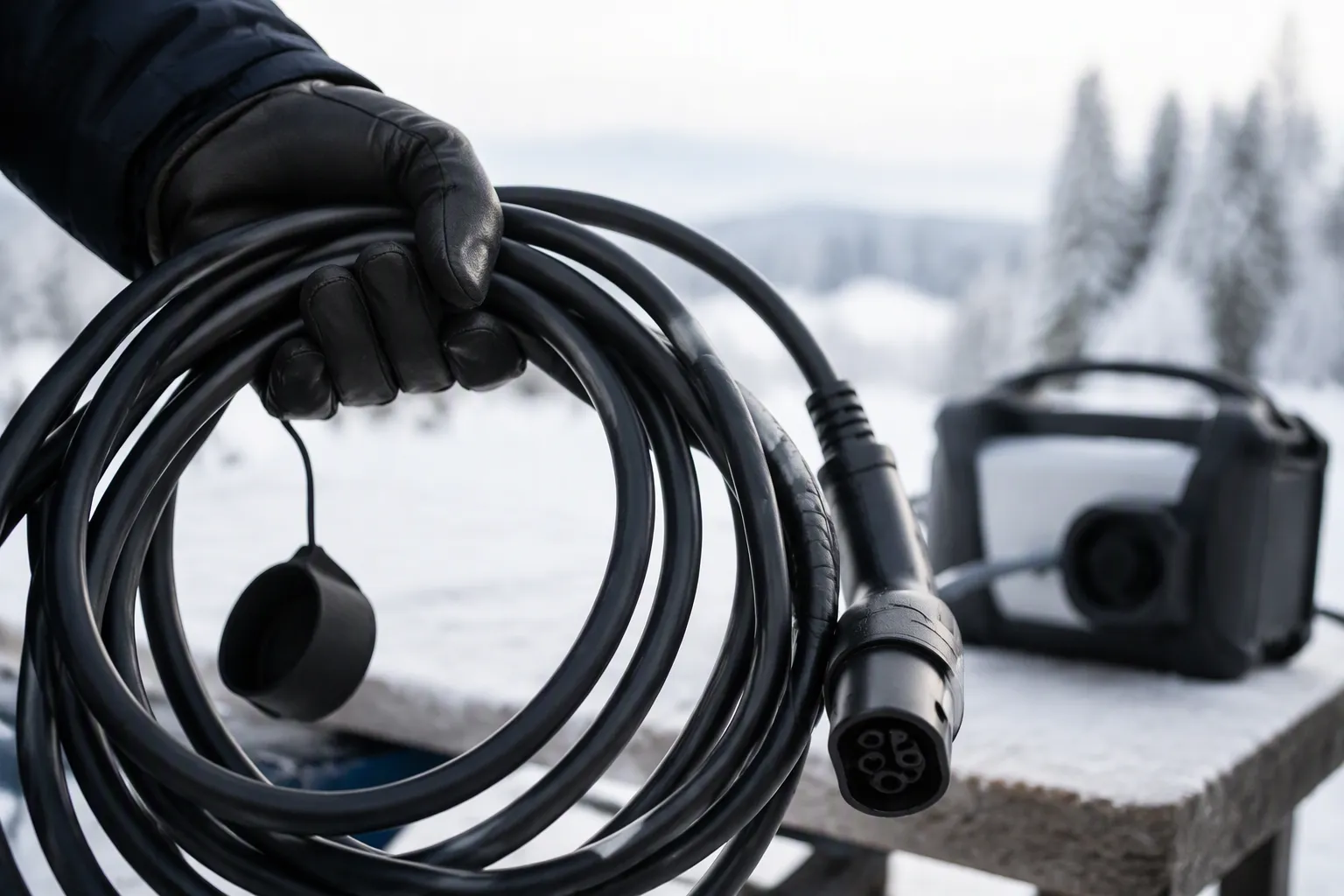
A special low-temperature flexible wire is the key part of any serious cold-weather charging cable. This compound keeps the insulation soft, and the way the wire strands are built resists the stiffness that solid wire shows in deep frost. Customized TPU cables go even further. Makers adjust the jacket formula for a target market, so a cable sold in Tromsø acts differently from one sold in Marseille.
Portable EV charger units are the top choice in Norway and Sweden, and most of them come with a TPU or silicone cable jacket. That choice makes sense. A portable ev charger gets coiled, hung, and dragged all its life, often at temperatures well below freezing. A tpu or silicone cable jacket keeps that daily handling easy. Buyers who want proven reliability should look at reliable anti-freeze charging cable models from established suppliers. DUOSIDA, the EV charging brand of Zhangjiagang UCHEN New Energy Technology Co., Ltd. (Youcheng Technology, stock code: 873087), builds charging connection devices and stations backed by UL, CSA, TUV, BS, CE, PSE, and 16949 certification. The company has served mainstream car makers and top charging pile companies in Europe and America since 2004, which gives Nordic buyers a track record to check.
Jacket Materials: TPU, Silicone, and FR TPE
Each jacket family earns its place. Flame-retardant TPEs give flexible, safe sheathing for high-performance anti-freeze EV charging cables. Strong FR TPU compounds add mechanical strength and abrasion resistance. Halogen-free grades, including cross-linked options, hold steady performance from high UV and moisture exposure down to sub-zero temperatures. These compounds aim for compliance with UL 62, UL 2263, and EN50620.
Property | TPE Jacket | TPU Jacket |
|---|---|---|
Low-temperature toughness | No cracking at -40°C; brittleness temperature down to -50°C | No cracking at -50°C |
Flame retardancy | VW-1, halogen-free | VW-1, halogen-free |
Abrasion and mechanical | High elasticity, elongation up to 580% | Enhanced strength and abrasion resistance |
Environmental | Halogen-free, recyclable | Halogen-free |
Silicone-based additives make TPU even better. They improve abrasion and scratch resistance, extend service life under frequent bending, and cut surface friction for easier handling. Silicone modification also keeps bendability at low temperatures, so the cable stays flexible down to -40°C. The result stays recyclable and meets RoHS and REACH.
Three trends shape 2026. Lightweight designs reduce the load on hanging cables. Liquid-cooled technologies support higher power in compact packages. Better weather resistance extends service life in extremely cold conditions. Together they push cable flexibility and mechanical durability higher across every jacket type. DUOSIDA's cold-rated cables and tpe or tpu cables fit this direction, and buyers can match a jacket to their site rather than settle for a generic option.
Choosing and Installing Cold-Climate Chargers
Matching Ratings to Site Conditions
Buyers should begin with an outdoor-rated electric vehicle charging station that has weather certifications for the site. A unit rated IP67 keeps out dust and survives water immersion. An IK10 impact rating helps it handle accidental drops and mechanical stress in cold conditions. The minimum operating temperature should be lower than the coldest night the site expects.
A deployment project in Norway, where local temperatures can drop to -30°C, shows that cold-weather reliability depends on both the IP rating and the electrical performance of the station.
Rating / Test
Value
Relevance to Nordic Winter
Ingress protection
IP67
Blocks snow, ice, and moisture
Impact resistance
IK10
Handles drops and stress in cold
Operating range
-30°C to 60°C
Covers Nordic winter lows
Cold chamber test
48 hours at -40°C, then power on
Margin beyond the rated range
Hot chamber test
48 hours at 85°C
Thermal robustness
Planners should also add extra units to cover winter demand. Snow and ice slow every session, so more units keep lines short. A canopy over exposed spots shields hardware from ice buildup and blowing snow. These choices support cold-weather charging across a whole ev charging infrastructure.
Winterizing Stations and Cable Habits
Cold weather makes a cable jacket less bendable. Drivers should coil cables gently and avoid sharp bends while frozen, since tight wraps crack the jacket and damage internal wires over time. An insulated sleeve adds protection in extreme climates.
Loop the cable loosely into 12–18 inch diameter loops instead of wrapping it around the charger body.
Keep the connector clean and covered with its dust cap.
Store a portable ev charger in a padded case with its own spot in the trunk.
Hang cables on dedicated hooks and keep connectors off the ground.
Never force a stiff cable; straighten it gently before use.
These habits protect mechanical durability through many winters. A portable ev charger in winter deserves the same care as any other cold-sensitive tool.
Cold embrittlement and seal failure start the problem. Cold-rated jacket materials end it. TPU and silicone jackets, plus flame-retardant TPE, keep cables bendable far below freezing. Wide operating ranges, IP-rated sealed connectors, and careful installation and storage finish the job.
The 2026 takeaway is a short checklist. Check the temperature rating, the jacket compound, and the IP class before you buy. Then match the cable to the site's real winter conditions. That approach works well for charging solutions for nordic markets.
Cold weather flexibility should be written into the spec, not treated as an afterthought. Buyers who include it in the spec, along with mechanical durability, get cables that still coil on the coldest morning.
FAQ
Which jacket material suits the coldest Nordic sites?
Polyether TPU and silicone handle deep cold best. TPU stays flexible to about −50°C, and silicone works across a −60°C to −100°C glass transition range. Cold-rated TPE holds to −40°C but feels stiffer in extreme cold. Buyers should match the compound to the site's lowest expected temperature.
Does a higher IP rating guarantee winter reliability?
No. IP66 and IP67 cover water jets and short immersion, not snow or sleet. Buyers should pair the IP class with the maker's operating-temperature range and outdoor-use guidance. Seal condition and daily connector care decide long-term performance just as much.
How can a buyer verify cold-bend performance?
Ask three questions. Which standard did the lab follow, such as IEC 62893 or EN 50620? At what temperature did the sample bend? Did the test cover the full assembly with its connector? A supplier who answers all three gives the buyer a result to check.
Why do portable EVSEs dominate in Norway and Sweden?
Portable units get coiled, hung, and dragged throughout their service life, often well below freezing. Most ship with a TPU or silicone jacket, and those compounds keep daily handling easy. That combination fits the way Nordic drivers actually use charging equipment.
What storage habits protect a cable through winter?
Drivers should loop cables loosely into 12–18 inch coils instead of wrapping them around the charger body. They should keep connectors capped and off the ground, store portable units in a padded case, and never force a stiff cable. Gentle straightening before use prevents jacket cracks.