
Inside a NACS Liquid-Cooled Charging Plug: Key Components Explained
 2026-11-16

As electric vehicle fast-charging infrastructure continues to develop, charging connectors are facing higher requirements for current capacity, thermal management, electrical safety, and everyday usability. For high-power DC charging equipment, the connector is not simply a plug that transfers electricity. It is an integrated component that combines conductive contacts, insulation materials, mechanical protection, cable connections, and cooling-related design.
A NACS liquid-cooled charging plug is designed to support high-current charging while managing the heat generated during operation. Understanding its key components helps charging station manufacturers, EV infrastructure developers, and procurement teams evaluate whether a product meets their technical requirements.
The DUOSIDA NACS Liquid Cooled Charging Plug, model DSN-EV-600LP, is one example of this product category. Developed by Zhangjiagang UCHEN New Energy Technology Co., Ltd. (Youcheng Technology, stock code: 873087), it is designed to meet North American Charging Standard SAE J3400-2023 requirements and supports a maximum constant current of 600A.
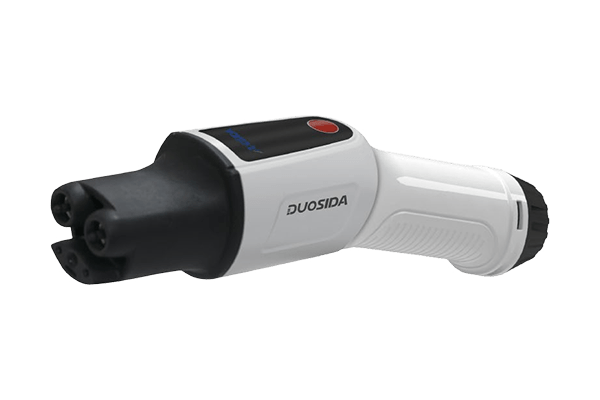
1. Connector Housing: The First Layer of Mechanical Protection
The outer housing is the part users handle when connecting and disconnecting a charging plug. It protects internal components and provides the physical structure needed for regular operation.
For a high-power charging plug, housing design needs to balance several requirements:
Mechanical strength to withstand daily handling
Electrical insulation to protect users
Resistance to environmental conditions
Comfortable grip and practical operation
Adequate space for internal electrical and cooling-related components
The DSN-EV-600LP uses thermoplastic housing material with a UL94 V-0 flame-retardant grade. This material specification is relevant to electrical equipment applications where flame-retardant performance is an important consideration.
The product also features an ergonomic design intended to make the plug easier to handle. For public charging stations and commercial charging facilities, practical handling matters because connectors may be used repeatedly by different drivers throughout the day.
2. Conductive Contacts: The Core of Power Transmission
The conductive contacts are among the most important components inside a charging plug. They establish the electrical connection between the charging station connector and the vehicle inlet.
For high-current charging, contact material and surface treatment can influence electrical resistance, heat generation, and long-term connection performance.
The DUOSIDA NACS liquid-cooled charging plug uses copper alloy contact sleeves with silver plating.
Each part of this material combination serves a practical purpose:
Copper alloy: Provides the conductive foundation for transferring electrical current.
Silver plating: Provides a conductive surface finish and helps support reliable electrical contact.
Contact resistance is an important specification when evaluating a high-power connector. Higher resistance at the contact interface can contribute to additional heat generation under high-current conditions.
The DSN-EV-600LP specifies a maximum contact resistance of 0.5 mΩ and a terminal temperature rise below 50K. These figures provide useful reference points for charging equipment manufacturers assessing electrical and thermal performance.
The product also lists a maximum rated current of 600A under constant-current conditions and an operating voltage of 1000V.
These ratings should always be considered together with the vehicle inlet, charging station output, cable assembly, and operating conditions. A connector's maximum rating does not automatically mean that every connected vehicle can charge at that level.
3. Liquid Cooling System: Controlling Heat During High-Current Charging
As current increases, heat generated by electrical resistance becomes a more important design consideration. This is particularly relevant to the contact area and conductive components of a high-power charging plug.
Liquid cooling helps manage this heat by using a circulating cooling medium as part of the connector's thermal management arrangement.
For charging equipment manufacturers, several cooling-related parameters need to be checked:
Compatible cooling medium
Maximum coolant temperature
Rated working pressure
Cooling system compatibility
Operating conditions during continuous charging
For the DSN-EV-600LP, the published specifications include a rated working pressure of 0.8 MPa and a maximum coolant temperature of 85°C. The listed applicable cooling media include silicone oil, electronic fluorine liquid, Shell E4, and FUCHS 8016.
These details are important during charging system integration. The selected cooling medium and circulation arrangement must be compatible with the connector and the complete charging equipment.
It is also important to distinguish between the connector's cooling capability and the performance of the charging station as a whole. Actual thermal performance depends on the complete cooling circuit, current level, ambient conditions, and charging duration.
4. Insulation and Electrical Safety Components
A high-power charging plug must provide electrical insulation between conductive parts and its external structure. Insulation performance helps reduce the risk of unintended current paths and electrical leakage.
When evaluating a NACS liquid-cooled charging plug, buyers should pay attention to several electrical parameters rather than relying only on the rated current.
The DSN-EV-600LP publishes the following specifications:
Insulation resistance: ≥2000 MΩ at room temperature
Withstand voltage: 3000V for one minute
Leakage current during the specified withstand-voltage test: less than 5mA
Terminal temperature rise: less than 50K
These values provide a technical basis for product evaluation and comparison.
For manufacturers integrating connectors into DC fast-charging equipment, electrical validation should cover the complete assembly and follow the applicable product and system requirements. The connector's published specifications should not replace system-level testing.
5. Cable Assembly: Connecting the Plug to the Charging Equipment
The cable assembly is another important part of a liquid-cooled charging plug. It carries electrical power between the charging station and the connector while also needing to accommodate practical handling requirements.
Cable selection affects more than current transmission. It can also influence:
Cable flexibility and handling
Installation space and routing
Mechanical stress around the connector
Compatibility with the charging station
Integration with the cooling arrangement
For a high-current liquid-cooled connector, the cable and cooling design need to be evaluated together. The cable assembly must be suitable for the intended current and voltage, and its configuration should match the connector manufacturer's specifications.
The DUOSIDA product page identifies the DSN-EV-600LP as a 600A maximum constant-current model. Buyers should confirm the detailed cable configuration and assembly requirements with the supplier when preparing a specific charging equipment project.
6. Mechanical Design: Making the Connector Suitable for Repeated Use
Charging plugs in public and commercial charging environments may be connected and disconnected thousands of times. Mechanical design therefore has a direct influence on usability and maintenance planning.
The DSN-EV-600LP provides several published mechanical performance specifications:
| Performance Item | Published Specification |
|---|---|
| Mechanical lifespan | More than 10,000 no-load insertion/withdrawal cycles |
| Coupled insertion force | ≤100N |
| Impact resistance | 1-meter drop and 2-ton run-over test |
| Operating temperature | -30°C to +50°C |
| Interior protection rating | IP67 |
These specifications help buyers understand the product's stated mechanical and environmental performance.
The IP67 rating is specified for the interior of the connector. When evaluating protection requirements, buyers should confirm the exact test conditions and the protection level applicable to the complete charging assembly.
Mechanical performance also depends on proper installation, cable support, handling practices, and regular inspection.
7. How the Components Work Together
A NACS liquid-cooled charging plug should be evaluated as an integrated product rather than a collection of independent parts.
During charging, the conductive contacts establish the electrical connection. The insulation system separates conductive areas from surrounding components. The housing provides mechanical protection and a usable grip, while the cable assembly connects the plug to the charging equipment. The liquid-cooling arrangement helps manage heat under high-current operating conditions.
If one part is not properly matched to the others, the overall charging system may not achieve its intended performance.
For example, selecting a 600A connector without confirming the charging station's cooling capacity and vehicle-side requirements may lead to an unsuitable system configuration. Similarly, choosing a connector based only on its external appearance does not provide enough information about electrical or thermal performance.
A practical evaluation should therefore include the following checks:
Confirm that the connector meets the required charging standard.
Match the rated voltage and current with the vehicle and charging station.
Review contact material, resistance, and temperature-rise specifications.
Check cooling medium compatibility and working pressure.
Verify insulation and protection ratings.
Review mechanical lifespan, insertion force, and impact resistance.
Confirm cable configuration and system integration requirements.
8. DUOSIDA NACS Liquid-Cooled Charging Plug for Charging Equipment Projects
Zhangjiagang UCHEN New Energy Technology Co., Ltd., known as Youcheng Technology (stock code: 873087), focuses on the development and market promotion of high-performance charging products for new energy vehicles.
Its DUOSIDA product portfolio covers multiple EV charging categories, including NACS products, HPC products, charging sockets and plugs, charging stations, adapters, vehicle outlet sockets, electric locks, and high-voltage connectors.
For customers developing North American charging equipment, the DUOSIDA NACS Liquid Cooled Charging Plug provides a specific product option for evaluation.
The DSN-EV-600LP is listed with a maximum constant current of 600A, a rated operating voltage of 1000V, liquid-cooling-related specifications, copper alloy silver-plated contact sleeves, and a UL94 V-0 thermoplastic housing. Its published mechanical and electrical parameters also give engineering teams useful information for preliminary product assessment.
Beyond this individual product, buyers can explore the DUOSIDA EV charging product portfolio to review other charging components and equipment for different application requirements.
Conclusion
A NACS liquid-cooled charging plug combines several important components to support high-power DC charging. The housing provides mechanical protection, conductive contacts transfer electrical power, insulation supports electrical safety, the cable assembly connects the charging equipment, and liquid cooling helps manage heat during high-current operation.
For charging station manufacturers and infrastructure developers, understanding these components makes product evaluation more practical. Current rating alone is not enough. Contact resistance, temperature rise, cooling requirements, mechanical performance, and charging standard compatibility should all be considered before selection.
With its DSN-EV-600LP NACS liquid-cooled charging plug, Youcheng Technology provides a 600A maximum constant-current product option for SAE J3400-2023-related charging applications. Reviewing the published specifications and confirming system compatibility with the supplier can help buyers make a more informed decision for their charging projects.