
How High-Power Charging Connectors Support Electric Truck Operations
 2026-11-09

Electric trucks are becoming an increasingly practical option for logistics, freight transportation, port operations, construction sites, and regional delivery fleets. However, moving from diesel vehicles to electric trucks involves more than replacing the powertrain. Charging infrastructure must be able to support demanding operating schedules, high energy consumption, and frequent vehicle use.
For heavy-duty electric trucks, charging connectors are a critical part of this infrastructure. They provide the physical and electrical interface between the charging equipment and the vehicle. Their current-carrying capacity, thermal performance, mechanical durability, and compatibility can directly influence how efficiently a fleet is charged and how reliably its vehicles return to work.
High-power charging (HPC) connectors are designed to support charging applications that require substantial current. For electric truck operators, choosing the right connector is therefore an important step in building a charging system that matches actual fleet requirements.
1. Why Electric Truck Fleets Need High-Power Charging
The charging requirements of an electric truck are different from those of a passenger car. Trucks often carry heavier loads, travel longer distances, and operate according to fixed delivery or shift schedules. Their battery capacity and energy consumption may also be considerably higher.
Consider several common operating scenarios:
Long-haul and regional logistics: Trucks need to recharge during planned rest periods or between delivery routes.
Distribution centers: Vehicles may return to a depot in batches and need to be ready for the next shift.
Port and terminal operations: Electric trucks can be required to operate repeatedly throughout the day, with limited downtime.
Construction and industrial transportation: Charging may need to be coordinated around changing work schedules and site conditions.
In these environments, charging time is closely connected to vehicle availability. A charging system with insufficient current capacity may create bottlenecks when several trucks need to recharge within the same time window.
High-power charging connectors help address this challenge by supporting higher current levels when the vehicle, charging station, battery, and power supply are all designed for the application. The connector alone does not determine charging speed, but it is an essential component of the overall system.
2. How Connector Current Capacity Influences Fleet Charging
Current capacity is one of the first specifications fleet operators and charging equipment manufacturers should evaluate.
A connector rated for a higher current can support greater power transfer under suitable operating conditions. For DC charging, power is determined by voltage and current:
Power (kW) = Voltage (V) × Current (A) ÷ 1,000
For example, at a nominal voltage of 1,000 V, a current of 400 A corresponds to 400 kW, while 600 A corresponds to 600 kW. These figures are illustrative calculations rather than guaranteed charging outputs. Actual charging power depends on the vehicle battery, charger output, connector limits, cooling system, and charging control strategy.
For truck fleet planning, the important question is not simply whether a connector has the highest current rating. It is whether the connector can support the intended vehicle and charging system safely and consistently.
A fleet with moderate daily mileage may not need the same charging configuration as a long-distance truck operating on a tightly scheduled route. Selecting a suitable current rating helps avoid both under-specification and unnecessary system complexity.
3. Liquid Cooling: Managing Heat During High-Current Charging
Heat management becomes increasingly important as current rises. Electrical resistance at contact points and within conductive components generates heat during charging. If this heat is not managed effectively, it can affect operating stability and component service life.
Liquid-cooled HPC connectors use a cooling medium to help remove heat from the connector assembly. This approach can support high-current charging while managing temperature within the product’s specified operating range.
For electric truck applications, thermal performance should be evaluated in relation to:
The expected charging current and duration
The cooling medium and cooling-system design
Ambient temperature at the charging location
Cable and connector configuration
Temperature monitoring and charging control
The maintenance requirements of the cooling circuit
Liquid cooling is not a substitute for correct system design. The charging station and connector must work together, and the operating conditions must remain within the manufacturer’s specifications.
4. Product Examples: HPC Connectors for Different Charging Requirements
Youcheng Technology, also known as Zhangjiagang UCHEN New Energy Technology Co., Ltd. (stock code: 873087), is positioned as a charging solution service provider in China. The company focuses on the development and market promotion of high-performance charging products for new energy vehicles.
Its HPC product range includes connector configurations intended for high-current charging applications.
HPC Products Rated at 400A, 500A, 600A, and 800A Constant Current
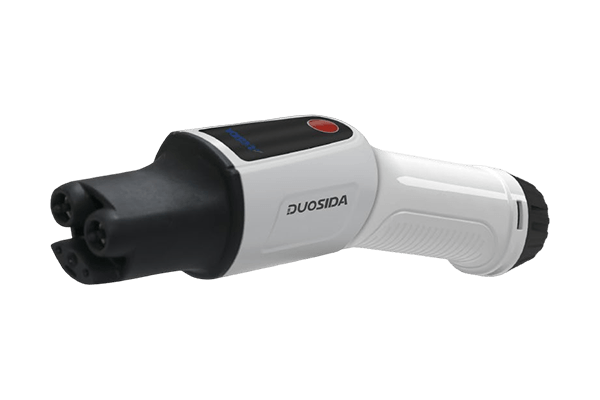
The HPC connector product rated at 400A, 500A, 600A, and 800A constant current is a liquid-cooled charging product designed around the fifth-generation UCHEN DC charging connector.
According to the product specifications, it features:
Rated current options of 400A, 500A, 600A, and 800A constant current
Operating voltage of 1500V DC
Plug head compliance with GB/T 20234.3
Internal protection rating of IP67 and coupled protection rating of IP55
Mechanical lifespan exceeding 10,000 no-load insertion and withdrawal cycles
Operating temperature range of -30°C to +50°C
Impact resistance against a 1-meter drop and a 2-ton run-over test
The product also lists a motorized electronic lock with manual unlocking capability. These specifications provide reference points for charging equipment developers considering high-current GB/T applications.
For electric truck charging projects, the appropriate configuration should be determined based on vehicle-side compatibility, charging station output, cable assembly, and the intended duty cycle.
HPC Products Rated at 600A Maximum Constant Current
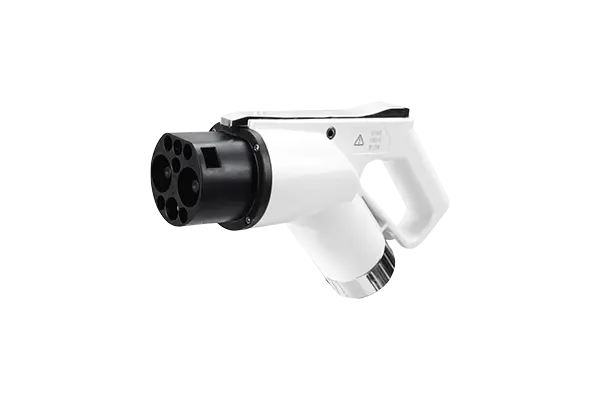
The HPC connector rated at 600A maximum constant current is another product option. Its published specifications identify compatibility with the North American Charging Standard SAE J3400-2023 requirements.
Key listed specifications include:
Maximum rated current of 600A constant current
Operating voltage of 1000V
Internal protection rating of IP67
Mechanical lifespan exceeding 10,000 no-load insertion and withdrawal cycles
Coupled insertion force of no more than 100N
Operating temperature range of -30°C to +50°C
Terminal temperature rise below 50K
Thermoplastic housing with UL94 V-0 flame-retardant grade
The product page also specifies cooling media options and a maximum coolant temperature. These details are relevant when the connector is integrated into a liquid-cooled charging system.
The two product examples serve different technical configurations. The 400A–800A product is listed for GB/T charging, while the 600A maximum product is listed for SAE J3400-related applications. They should not be treated as interchangeable without confirming the charging standard and vehicle interface.
5. Connector Durability Matters in Daily Truck Operations
A charging connector used in a commercial fleet may be connected and disconnected many times each day. Frequent handling, cable movement, accidental impact, and exposure to outdoor conditions can place mechanical demands on the connector.
For fleet operators, durability is not just a product specification. It can affect maintenance frequency and the availability of charging equipment.
When assessing a connector, buyers should review:
Insertion and withdrawal lifespan: A stated mechanical cycle rating can help estimate suitability for repeated use. The actual service life will also depend on handling and operating conditions.
Impact resistance: Charging equipment in truck depots and logistics yards may be exposed to accidental contact or cable handling incidents. Impact-resistance testing provides a useful reference.
Protection rating: Ingress protection should be checked for the connector in its relevant state, such as unmated or coupled. The rating does not eliminate the need for proper installation and maintenance.
Ergonomics: Connector weight, grip design, insertion force, cable flexibility, and locking mechanisms can affect how easily drivers or maintenance personnel use the equipment.
These factors become particularly important at busy depots where charging equipment is shared among multiple drivers.
6. Compatibility Must Be Confirmed Before Procurement
High-power charging projects require coordination among the vehicle manufacturer, charging station supplier, connector manufacturer, and infrastructure operator.
Before selecting an HPC connector, procurement teams should confirm the following:
Charging standard: Determine whether the vehicle uses GB/T, SAE J3400, or another applicable interface.
Vehicle-side requirements: Confirm the inlet configuration, voltage range, current demand, and communication requirements.
Charging station output: Verify that the charger can provide the intended power and current.
Cooling arrangement: Confirm whether liquid cooling is required and whether the connector is compatible with the selected cooling circuit.
Cable assembly: Check conductor sizing, cable length, routing, and handling requirements.
Environmental conditions: Review ambient temperature, exposure to dust or moisture, and expected operating conditions.
Validation and documentation: Request product drawings, specifications, test reports, and relevant compliance documentation for the exact model.
This process is especially important for electric truck projects because the charging interface must match the vehicle and charging infrastructure—not merely meet a high current rating on paper.
7. Building a Charging System Around Fleet Operations
A practical charging plan starts with the fleet’s operating schedule.
For example, a depot-based fleet may return vehicles at the end of a shift and charge them overnight. In this case, the number of charging points, available grid capacity, and charging time window may be more important than the maximum current rating of an individual connector.
A regional delivery fleet with short turnaround times may place greater emphasis on high-current charging and thermal management. A port or industrial fleet operating continuously may need to consider charging-point availability, connector durability, and maintenance access.
Operators should also consider whether charging will be centralized or distributed. A charging hub serving multiple vehicles may require a different layout and power-management strategy from a smaller depot with a limited number of trucks.
High-power connectors are one component of this planning process. Their value is realized when the connector, charging station, vehicle battery, electrical supply, and fleet schedule are designed to work together.
8. Working with a High-Power Charging Product Supplier
For charging equipment manufacturers and fleet infrastructure developers, supplier evaluation should include more than a product’s headline current rating.
Useful questions include:
Can the supplier provide products for the required charging standard?
Are detailed technical specifications available for the exact model?
Can the supplier support compatibility checks and application discussions?
Are cooling requirements and operating limitations clearly documented?
Is there a product portfolio that can support different charging configurations?
Youcheng Technology focuses on high-performance EV charging products and offers a range that includes HPC products, charging sockets and plugs, NACS products, charging stations, adapters, vehicle outlet sockets, and high-voltage connectors.
Its product information can be reviewed through the DUOSIDA EV charging solutions website. For projects involving electric trucks, buyers can use the published HPC product specifications as a starting point for technical discussions and system integration.
Conclusion
High-power charging connectors play an important role in supporting electric truck operations. Current capacity helps define the potential charging power, liquid cooling supports thermal management, and mechanical durability contributes to reliable daily use. However, the connector must be selected in the context of the complete charging system.
For fleet operators, the most suitable solution depends on vehicle compatibility, charging schedules, power availability, environmental conditions, and maintenance requirements. For charging equipment manufacturers, accurate product specifications and early coordination with vehicle and infrastructure partners are essential.
By evaluating these factors together, electric truck fleets can develop charging infrastructure that better matches their operating demands. HPC products from suppliers such as Youcheng Technology provide technical options for high-current charging projects, with model-specific specifications serving as the basis for selection and validation.