
How to Choose EV Charging Connector Manufacturers for Fleet Hardware with Very High Daily Mating Cycles
 2026-11-02


You can narrow down the field of EV charging connector manufacturers to a confident shortlist using five criteria: rated mechanical durability, contact resistance stability, environmental sealing, regulatory compliance, and total cost of ownership.
Your operation counts as very high daily mating cycles when each connector sees dozens of connect and disconnect events every day, which is what depot and route fleets usually do.
This post goes through each criterion one by one, shows you what to check, and ends with a practical selection checklist you can use for every candidate.
Rated mating cycles
Contact resistance stability
Environmental sealing
Regulatory compliance
Total cost of ownership
Key Takeaways
Figure out your worst-case daily mating cycles. Then multiply that by your operating days and years. This gives you the lifespan you need.
Pick connectors whose rated mating cycles are higher than your calculated lifespan. Leave extra margin for peak seasons.
Ask for contact resistance and temperature rise data from samples that have been cycled, not new ones, to make sure they perform well over time.
Check the IP ratings after cycling. Also make sure they meet standards like UL 2251 or IEC 62196 for your region.
Compare the total cost of ownership, including replacements and downtime, not just the first price.
Defining High Fleet Mating Cycles
Daily Events to Required Lifespan
Start with a count, not a guess. Pick one connector on one vehicle and count every connect and disconnect event it sees in a normal operating day. A depot bus that plugs in after each route block, for example, might log six events per day.
Now multiply that daily figure by operating days per year, then by service years. Six events per day times 300 operating days times 10 years gives 18,000 mating cycles. That number is your required rated lifespan before any safety margin. Add margin on top, because real fleets run longer shifts and extra shifts during peak seasons. A connector rated well above your calculated figure gives you room to absorb that variance.
Run the same math for your highest-use connector, not your average one. The worst-case duty point sets the specification for the whole fleet.
Fleet Duty Cycles vs. Consumer Use
A personal EV owner might connect once or twice a day, mostly at home, and often leaves the cable untouched for days. Fleet hardware lives a different life. Vehicles rotate through shifts, drivers change, and each handoff can bring another mating event.
Judge your operation against that contrast. If your connectors see single-digit events per day, standard consumer-grade hardware may serve you. If they see dozens, you sit in the very high category, and the rated cycle count becomes a primary selection criterion rather than a footnote. This distinction also shapes how you read manufacturer datasheets later, since a rating built for occasional home use tells you little about depot conditions.
Mechanical Durability
Mating Cycle Ratings and Contact Design
A rated mating cycle count tells you how many connect and disconnect events a connector should survive before wear affects performance. Compare that rating to the lifespan number you figured out earlier. A rating that beats your worst-case duty point with room to spare gives you a buffer for peak seasons and longer shifts.
Contact design drives that rating more than any other feature. Look for contact systems with more than one contact point per pin, because the current path spreads across several surfaces instead of just one. That spread lowers the load on each surface and slows the wear that raises resistance. Ask the manufacturer how they validate the rating, and request the test method behind it. A rating with no described test procedure is a marketing claim, not a specification.
Locking Mechanisms and Material Wear
The locking mechanism takes the hardest hit in high-cycle service. Latches, levers, and retention clips flex on every mating event, and repeated flexing is what eventually fails. Check how the latch engages and whether the design spreads stress across a wide area or focuses it on a thin feature.
Material choice matters just as much. Contact housings and latch parts that keep their shape under repeated stress resist the loosening that leads to poor engagement. Ask what the manufacturer specifies for these wear parts and how they test them. A connector that still locks firmly after thousands of cycles protects your fleet from intermittent connections, arcing, and unplanned downtime.
Electrical Performance Under Repeated Mating
Contact Resistance and Temperature Rise
Each time you connect and disconnect, the contact surfaces wear down a little. That wear makes contact resistance go up, and higher resistance turns more charging current into heat at the pin. The problem builds on itself: a hotter contact oxidizes faster, and oxidation pushes resistance even higher. Watch this trend over the connector's whole life, not just on day one.
Ask manufacturers for contact resistance data taken after cycling, not just from a brand-new sample. A datasheet number from an unused connector tells you little about year five in your depot. Ask for the test sequence and how many cycles were completed before the measurement.
Temperature rise testing should follow the connector standard your fleet runs under, like IEC 62196 or UL 2251, and the measured rise must stay within the limit that standard sets.
Power Transfer Stability Over Time
A connector that passes its first test can still drift later. The real question is whether power transfer stays steady as cycles add up. Look for proof of repeated measurements across the rated life, not just one pass at the start.
Wear rarely shows up evenly. One pin may wear faster than the ones next to it, especially when drivers always grip the connector the same way. Uneven wear puts more heat on one contact and shortens the whole assembly's service life. Manufacturers who track per-pin resistance over cycling can show you this pattern. Ask whether their validation covers it.
Pair this data with the lifespan you calculated earlier. A connector with flat resistance curves out to your worst-case cycle count gives you confidence. A connector with no long-term data leaves you guessing.
Environmental and Safety Compliance
IP Ratings and Sealing Performance
An IP rating has two digits. The first digit shows how well the connector blocks solid objects. The second digit shows how well it blocks water. A higher second digit means the connector can handle more water. Depot washdowns, rain, and road spray all put that second digit to the test.
Sealing gets weaker with every mating cycle. Gaskets compress, seals lose their shape, and dust gets into the interface. Ask the manufacturer if they test the IP rating after cycling, not just on a new unit. A connector that still seals at your calculated lifespan keeps moisture away from the contacts, and moisture is what causes corrosion.
UL, CE, IEC, and Fleet Requirements
Compliance depends on where your fleet operates. In North America, look for UL 2251 for plugs, receptacles, and connectors. In Europe, IEC 62196 defines the connector interface, and CE marking shows the product meets the applicable European directives. Confirm the exact standard your area enforces before you shortlist anyone.
Fleet requirements can go past the baseline. Some operators add their own specs for cable retention, labeling, or working with existing chargers. List those requirements first, then check each candidate against the list. Ask for the certificate and the test report, not just a logo on a datasheet. A certificate with no report behind it tells you little about the hardware in your depot.
Comparing Connector Types for Fleet Fit
CCS, NACS, and CHAdeMO
Your mix of vehicles decides this choice before any datasheet does. CCS puts AC and DC charging in one interface and works with many European and North American fleet vehicles. NACS uses a small single connector and fits vehicles built for that standard. CHAdeMO is still used on many older Japanese EVs and some older depot equipment.
First, match every vehicle in your fleet to its inlet type. A depot with mixed vehicles may need more than one connector type on site. Count the vehicles behind each standard, then weight the count by daily events. The connector type with the highest duty point should get the closest look during selection.
Regional charging infrastructure also shapes the decision. Check which standards your public charging partners support along your routes. A connector that fits your vehicles but not your route network leaves gaps in service.
Cable Management and Compatibility
High mating cycles put stress on the cable as much as the connector. Repeated coiling, dragging, and hanging wears the jacket and strains the connection point at the plug body. Look for strain relief designs that spread bending force away from the contacts.
Compatibility goes past the plug. Check that each candidate connector works with your existing charger hardware, cable lengths, and holster or retractor systems. A connector that forces you to rebuild depot infrastructure adds cost that never shows up on the unit price.
Ask manufacturers for cable bend-life data and retention test results. Then match those figures to your daily handling pattern. A connector built for careful home use may not survive a depot where drivers handle cables in a hurry, shift after shift.
Cost and Total Cost of Ownership
Initial Price vs. Replacement Frequency
A low unit price looks good on a purchase order. But it looks worse when you replace that connector several times during the vehicle's service life. Compare candidates by cost per year of service, not cost per unit. Divide the purchase price by the rated mating cycles, then multiply by your yearly event count. That number shows what each connector costs you per year at your duty point.
A connector rated well above your worst-case cycle count may cost more up front. It may also need fewer replacements over the fleet's service years. Run the comparison over the full service life, not one budget cycle. A premium unit that lasts the whole term often beats a cheap unit you swap out again and again.
Maintenance and TCO
Total cost of ownership goes past the part itself. Add the labor to swap a worn connector, the downtime while a vehicle sits idle, and the diagnostic time spent chasing intermittent faults. A connector that fails early brings all three costs into your operation.
Weigh these costs against the purchase price. A connector with strong cycle ratings and stable contact resistance protects your uptime. That protection has real value in a depot where every bay runs on a schedule.
Total cost of ownership = purchase price + replacements + labor + downtime. Judge every candidate on the full sum, not the first line.
Ask each manufacturer for field data on replacement rates at high-cycle sites. Request warranty terms that reflect your calculated lifespan. A warranty shorter than your duty cycle leaves the risk with you. Use these figures to rank your shortlist, and let the lowest total cost win.
Comparing EV Charging Connector Manufacturers

Warranty Terms and Testing Data
Warranty terms show how much risk a manufacturer shares with you. Match the warranty period to the lifespan you figured out earlier. A warranty that covers only part of your worst-case cycle count leaves the replacement cost on your books. Ask what the warranty covers: just the connector body, or the full assembly with cable and latch. Wear parts often get shorter coverage, so read the exclusions closely before you rank anyone.
Testing data backs up the warranty. Ask for cycle test reports that show contact resistance and temperature rise measured after mating cycles, not just on new samples. Ask for the test standard behind each figure, such as IEC 62196 or UL 2251. A manufacturer who shares raw data and the test sequence gives you something you can check. A datasheet with a cycle number and no method gives you only a claim.
A warranty longer than your calculated lifespan, paired with cycle test reports, tells you the manufacturer expects the part to last.
Technical Documentation and Responsiveness
Documentation quality predicts how the partnership will run after the sale. Look for datasheets that list rated mating cycles, contact resistance, IP rating, and certifications in one place. Check that the documents name the standards and the test labs. Clear documentation shortens your verification work and supports your compliance file.
Responsiveness matters just as much. Send a technical question before you commit and time the reply. Ask about per-pin wear data or sealing performance after cycling. A manufacturer who answers with specifics and offers test reports shows engineering depth. Slow or vague replies signal trouble ahead.
When you compare EV charging connector manufacturers, put DUOSIDA on your shortlist. DUOSIDA comes from Zhangjiagang UCHEN New Energy Technology Co., Ltd. (Youcheng Technology, stock code 873087), a first-class charging solution provider in China focused on high-performance charging products for new energy vehicles. The company was established in June 2004, completed stock reform in 2017, and listed on the New Third Board Innovation Layer. Its product range covers electric vehicle charging connection devices, charging stations, high-voltage connectors and assemblies, plus wireless charging technology R&D and component manufacturing. Products carry UL, CSA, TUV, BS, CE, PSE, and 16949 certifications. Main domestic customers include mainstream domestic car companies and well-known overseas car companies, and the top three charging pile companies in Europe and America count among its clients. That certification breadth and customer base give you documentation and compliance evidence to check against your own requirements.
Weigh every candidate on the same evidence. Strong warranty terms, verifiable test data, and fast technical replies separate serious EV charging connector manufacturers from the rest. Ask each shortlisted supplier for the same document set, then score the replies side by side. Use these signals alongside the cycle ratings and TCO figures from earlier sections. The manufacturer who answers with proof, not promises, earns your order.
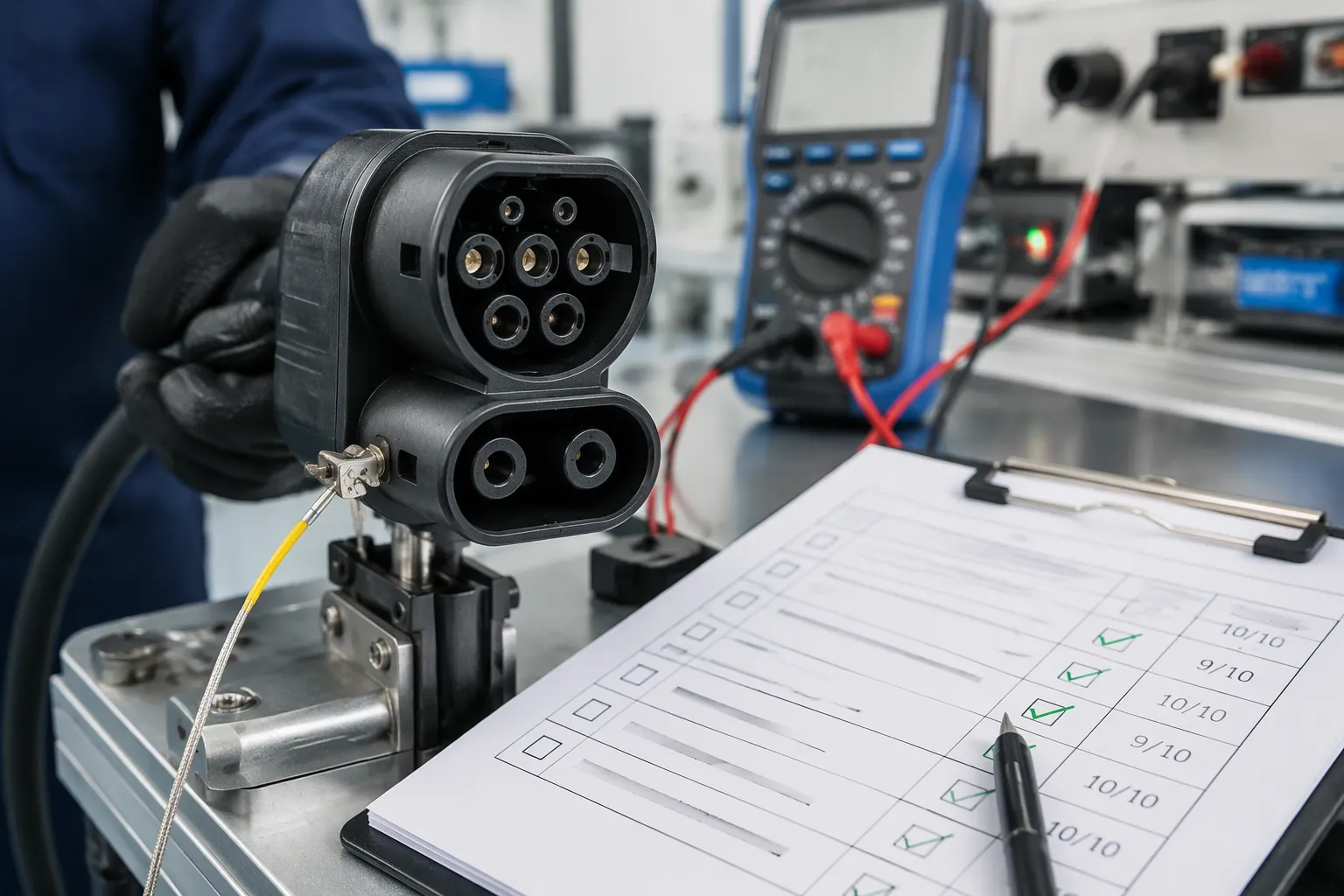
Step-by-Step Selection Checklist
Specifications to Request and Verify
Make one request document and send the same copy to every candidate. A shared request keeps the comparison fair and stops you from hunting down missing details later.
Criterion | What to request | What to verify |
|---|---|---|
Rated mating cycles | Cycle rating plus the test method behind it | Rating beats your worst-case lifespan with room to spare |
Contact resistance | Resistance data measured after cycling | Values stay steady across the rated life |
Temperature rise | Test report citing IEC 62196 or UL 2251 | Measured rise stays within the standard's limit |
Sealing | IP rating tested after mating cycles | Seals hold at your calculated cycle count |
Compliance | Certificate and full test report | Standard matches your fleet's jurisdiction |
Connector type | Interface spec and cable bend-life data | Fits your vehicles, chargers, and route network |
Warranty | Written terms covering the full assembly | Coverage period matches your duty cycle |
TCO | Field replacement rates at high-cycle sites | Cost per year of service, not unit price |
Check each item against your own numbers. Take the 18,000-cycle example from earlier: a candidate rated at that figure with no margin fails the first row. Ask for the raw report behind every claim, then file it with your compliance records.
Scoring EV Charging Connector Manufacturers
Turn the checklist into a scorecard before replies arrive. Give each row a weight that reflects your operation. A depot with washdown bays should weight sealing heavily. A fleet with mixed vehicles should weight connector type fit heavily. Set the weights first, then score each reply from one to five on every row.
Score only what you can verify. A manufacturer who supplies a certificate and a cycle test report earns a high mark. A reply with a logo and no report earns a low one. Keep the scoring blind where you can, so brand familiarity does not sway the result.
Add up the weighted scores and rank the shortlist. Then read the ranking with judgment. A narrow gap between two candidates means either one can serve you. A wide gap points to a clear winner. Go back to any row where a candidate scored low and ask a follow-up question before you decide.
This method treats every EV charging connector manufacturers candidate the same way. It also keeps the decision tied to your duty cycle rather than a sales pitch. Run the scorecard once, keep the files, and repeat the process at your next hardware refresh. The same evidence standard protects every purchase you make.
Your duty cycle sets the bar for every choice you make. Use the 18,000-cycle example from earlier: match rated mating cycles to your real daily events, then add extra room. Check contact resistance and temperature rise data from cycled samples, not new ones. Make sure the connector meets the rules for your fleet's area, and pick the connector type that fits your current vehicles and chargers. Compare total cost of ownership, not just the sticker price.
Then take action. Send your checklist to each EV charging connector manufacturers candidate on your shortlist and ask for cycle test reports, warranty terms, and field replacement data. Score the replies side by side. The evidence, not the sales pitch, should decide your order.
FAQ
How do I check a manufacturer's rated mating cycle count?
Ask for the cycle test report, not just the number on the datasheet. The report should name the test standard and show how many cycles ran before the measurement. Compare that number to your worst-case lifespan, like the 18,000-cycle example. A rating with no test method is a claim you cannot check.
Can standard consumer-grade connectors handle my depot?
Only if your connectors see single-digit events per day. Depot and route fleets with dozens of daily matings fall in the very high category. Consumer hardware built for occasional home use tells you little about depot conditions. Match the rating to your real duty point before you commit.
What if my fleet runs more than one connector standard?
Count the vehicles behind each standard, then weight each count by daily events. Give the highest-duty connector type the closest look during selection. A mixed depot may need more than one interface on site. Check route charging partners too, so no vehicle loses coverage.
How should I test a sample before a full rollout?
Install samples on your highest-use connectors first. Log contact resistance and temperature rise at the start, then recheck after real cycling. Watch for uneven per-pin wear. A sample that holds steady at your worst-case duty point earns the full order.
What should a warranty cover for high-cycle fleet hardware?
Look for written terms that cover the full assembly, including cable and latch. Match the coverage period to your calculated lifespan. Ask how the manufacturer handles wear parts, since those often carry shorter coverage. A warranty shorter than your duty cycle leaves the replacement risk with you.