
Best Manufacturers for Charging Networks You Can Trust
 2026-11-02


ABB E-mobility, Alpitronic, Kempower, Tritium, and BTC Power are among the best manufacturers for charging networks built around connectors, cables, and spare parts that can be replaced in the field. Each one is judged on four points: technical performance, fit for the job, regulatory compliance, and cost.
Field-replaceable design keeps chargers running. A technician swaps a worn connector or damaged cable on site instead of replacing the whole unit. Service visits drop, downtime falls, and the total cost of ownership improves over the life of the asset.
Use this guidance to match a maker to your deployment scenario. The best manufacturers for charging networks differ by site type, power level, and budget, so fit matters more than a single ranking.
Key Takeaways
Pick chargers that let you swap out parts on site. This cuts downtime and saves you money.
Before you pick a manufacturer, check three things: how well its equipment works, whether it meets the rules, and how much it costs.
Pick the manufacturer that fits your site type: highway, fleet depot, or urban network.
Check that spare parts are in stock and know how long delivery takes. This helps keep your network running.
Ask for a five-year parts quote so you can compare the total cost of ownership.
Why Field-Replaceable Components Matter
Uptime and Serviceability
A charging site only makes money when its units give out energy. A worn connector latch or a damaged cable can knock a whole dispenser offline. Field-replaceable parts change that result. A trained technician takes out the failed part and fits a spare right at the site, often in one visit.
This design choice also makes service planning easier. Operators can keep the parts that fail most often, like connectors, cables, and contactor assemblies, and send a technician with the right part on the first trip. Fewer return visits mean shorter outages and less trouble for drivers. Network teams can also plan replacement during low-traffic hours instead of waiting for a full unit swap.
Total Cost of Ownership
The money side follows the same logic. A full dispenser replacement carries the cost of the hardware, shipping, crane work, and setup. A field-replaceable connector or cable carries only the part and the labor to fit it. Over a service life of many years, that gap grows with every repair.
Spare-parts strategy matters here too. Manufacturers that publish part numbers and keep consumables in stock let operators plan budgets with confidence. Predictable maintenance spending supports better pricing decisions and steadier returns on each site. Buyers should confirm parts availability and lead times before committing to a platform, because a replaceable part is only valuable when it can really be sourced.
Evaluation Criteria
Technical Performance and Application Fit
Technical performance includes power output, efficiency, connector types, and how the unit handles heat under a steady load. Buyers should look at the power curve, not just the peak rating. A unit that keeps high output through a long session serves highway traffic better than one that slows down early. Connector standards matter too. Make sure the platform supports the plugs your drivers really use, including CCS and NACS where relevant.
Application fit connects performance to the site. A depot with overnight parking needs different hardware than a corridor hub with ten-minute stops. Match the dispenser form factor, cable reach, and mounting options to the physical layout. Think about climate as well. Units placed in extreme heat or cold need tested operating ranges and cable jackets made for that environment. Ask each manufacturer for reference sites that are like your deployment.
Regulatory Compliance and Cost
Compliance is a pass-or-fail gate. Check certifications for the target market, such as UL listings in North America or IEC 61851 compliance in Europe. Network protocols deserve the same close look. Open Charge Point Protocol (OCPP) support protects your investment in backend software and avoids vendor lock-in. Confirm the certification level and the firmware version that carries it.
Cost analysis should go past the purchase price. Compare the price of consumable parts, typical lead times for spares, and warranty terms on field-replaceable components. A lower sticker price can lose its advantage when connectors cost more or arrive slowly. Ask for a maintenance cost estimate over a five-year horizon. Weigh that figure against uptime value, because a reliable unit with modest parts pricing often wins on total cost of ownership.
Best Manufacturers for Charging Networks
Side-by-Side Comparison
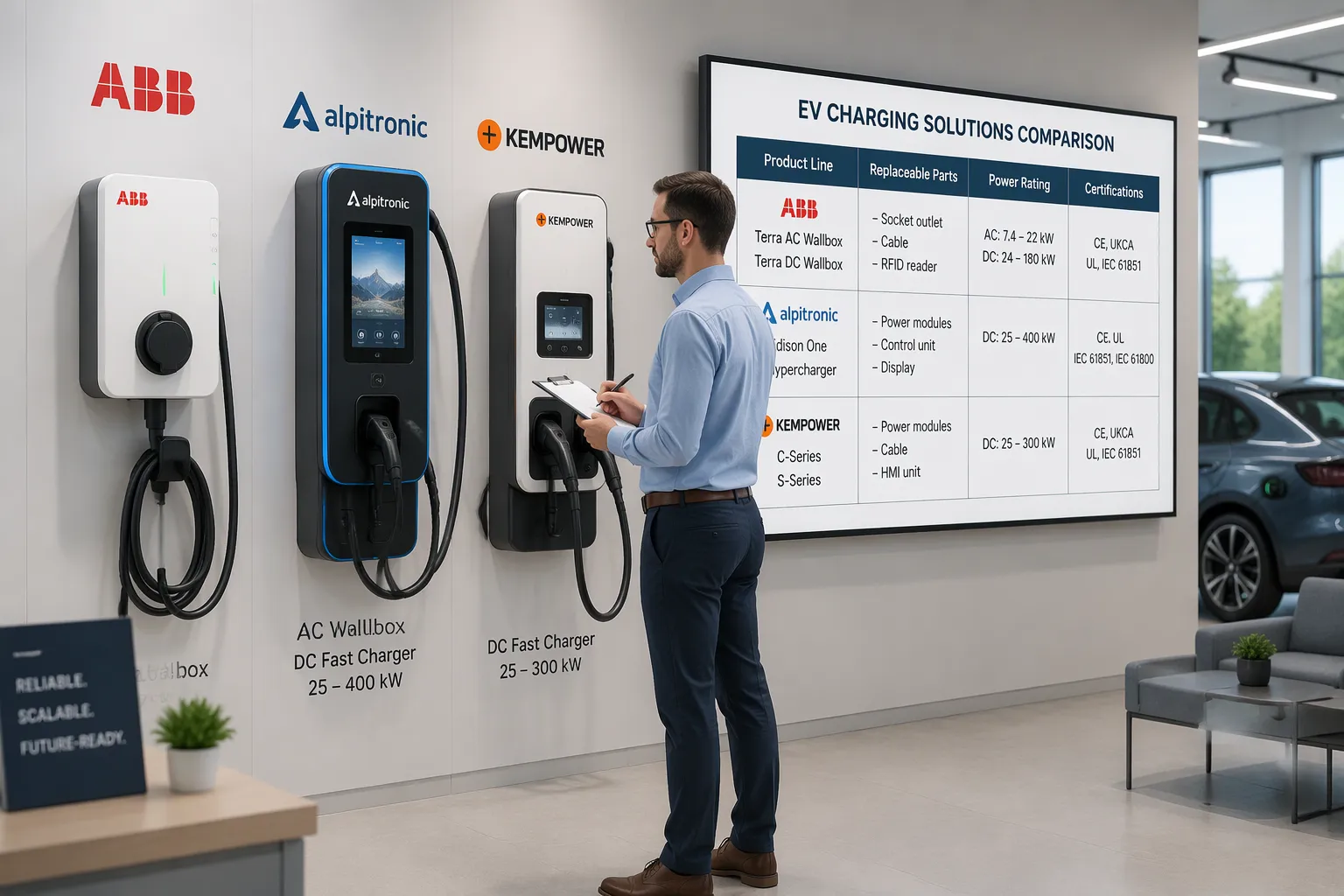
The table below compares the best manufacturers for charging networks on the points that decide a buying shortlist. Power ratings are shown as platform classes rather than single numbers, because each maker offers several models within a line.
Manufacturer | Product lines | Field-replaceable connectors, cables, spare parts | Power ratings | Compliance certifications | Cost positioning |
|---|---|---|---|---|---|
ABB E-mobility | AC wallboxes, DC fast chargers, high-power corridor units | Connectors, cables, and modular power cabinets designed for site swap | AC through high-power DC classes | UL, IEC 61851, OCPP | Premium |
Alpitronic | DC fast charging platforms, satellite dispensers | Cable and connector assemblies, serviceable power modules | High-power DC classes | CE, IEC 61851, OCPP | Mid-to-premium |
Kempower | Modular DC systems, depot and fleet dispensers | Plug-and-cable kits, modular cabinets, stocked consumables | Medium to high DC classes | CE, IEC 61851, OCPP | Mid-range |
Tritium | DC fast chargers for corridors and fleets | Cable assemblies, connector kits, sealed serviceable modules | High-power DC classes | UL, CE, OCPP | Mid-to-premium |
BTC Power | AC and DC chargers, fleet and public units | Connector and cable spares, replaceable sub-assemblies | AC through high DC classes | UL, OCPP | Value-to-mid |
DUOSIDA | EV charging connection devices, charging stations, high-voltage connectors and assemblies, wireless charging R&D, component manufacturing | Charging connection devices and connector assemblies built in-house | AC and DC connection device classes | UL, CSA, TUV, BS, CE, PSE, 16949 | Value-to-mid |
DUOSIDA (Zhangjiagang UCHEN New Energy Technology Co., Ltd., stock code 873087) is a top charging solution provider in China. It was founded in June 2004 and is listed on the New Third Board Innovation Layer. Its main customers include car companies at home and abroad, plus leading charging pile companies in Europe and America.
How to Read the Comparison
Start with the compliance column. If a certification is missing for your market, that maker leaves the shortlist, no matter how strong the hardware looks. Next, match the power class to your site. A corridor hub needs high-power DC lines, while a workplace lot may do fine on AC. Then check the field-replaceable column against your service model. A maker that stocks connectors and cables locally cuts repair time.
Cost positioning is the last filter, not the first. A premium platform can still win on total cost of ownership when parts are cheap and lead times are short. Use this table to narrow the list to two or three candidates, then read the detailed subsections below. Buyers comparing the best manufacturers for charging networks should also ask for a five-year parts quote from each finalist.
ABB E-mobility
Product Lines and Field-Replaceable Design
ABB E-mobility covers the whole charging chain. The lineup goes from AC wallboxes for daily parking to DC fast chargers and high-power corridor units for highway hubs. Network planners can get one platform family for all site types, which makes spare-parts planning and technician training simpler.
Field service is at the heart of the design. Connectors and cables are made for site swap, so a technician can replace a worn plug or damaged cable without pulling the dispenser. Modular power cabinets work the same way. A failed power module comes out and a spare goes in, and the rest of the cabinet keeps working. Operators should check local stock levels for these consumables before committing to a rollout.
Performance, Compliance, and Fit
The platform spans AC through high-power DC classes. Buyers should ask for the power curve for each model and check how output holds through a long session. Cable reach and mounting options matter for lot layout, and climate testing deserves a review for exposed corridor sites.
Compliance coverage is broad. ABB E-mobility products carry UL listings for North America and IEC 61851 compliance for Europe, and the platform supports OCPP for backend integration. Confirm the firmware version that carries each certification during procurement.
Cost positioning is premium. The purchase price sits above value-tier options, and the case rests on uptime and parts availability. Ask for a five-year parts quote and typical lead times. ABB E-mobility fits best where a mixed AC and DC network needs one vendor, proven compliance in both major markets, and service depth at scale.
Alpitronic
Product Lines and Field-Replaceable Design
Alpitronic makes DC fast charging platforms and satellite dispensers. The satellite design keeps the power cabinet apart from the dispenser at the curb. This setup works well for sites where space at the parking bay is tight and the power hardware can sit farther back.
Field service uses the same modular approach. Cable and connector assemblies are made to be replaced at the site, so a worn plug or damaged cable comes off without removing the dispenser. Power modules can be serviced the same way. A technician swaps the failed module and the rest of the cabinet keeps working. Procurement teams should check local stock for cable and connector kits before a rollout, because a replaceable part only cuts downtime when a spare is ready.
Performance, Compliance, and Fit
The platform falls in the high-power DC classes. Buyers should ask for the power curve for each model and check how output holds up during a long charging session. Cable reach and dispenser mounting should be reviewed against the site layout, and exposed corridor locations call for a look at the tested operating range.
Compliance coverage includes CE marking, IEC 61851 compliance, and OCPP support for backend integration. Confirm the firmware version that carries each certification during procurement, and check that the OCPP level matches your network software.
Cost positioning is mid-to-premium. The purchase price sits below the top tier, and the case rests on serviceable modules and parts availability. Ask each finalist for a five-year parts quote and typical lead times. Alpitronic fits best where a corridor or hub site needs high-power DC charging, a compact dispenser footprint, and a service model built around module swaps.
Kempower
Product Lines and Field-Replaceable Design
Kempower makes modular DC charging systems for depots, fleets, and public networks. The lineup pairs power cabinets with satellite dispensers, so one cabinet can feed several charging points. This setup suits sites that need to add stalls over time without replacing the whole installation.
Field service follows the same modular idea. Plug-and-cable kits let a technician replace a worn connector or damaged cable at the dispenser. Modular cabinets allow a failed power unit to come out while the rest of the system keeps serving vehicles. Kempower stocks consumables as standard parts, which shortens the wait for a replacement. Procurement teams should still confirm local stock levels and typical lead times before a rollout, because a stocked part in a distant warehouse does little for a site that is down.
Performance, Compliance, and Fit
The platform covers medium to high DC power classes. Buyers should request the power curve for each configuration and check how output holds through a long session. Cable reach and dispenser mounting deserve a review against the site layout, and outdoor depots call for a look at the tested operating range.
Compliance coverage includes CE marking, IEC 61851 compliance, and OCPP support for backend integration. Confirm the firmware version that carries each certification, and check that the OCPP level matches your network software.
Cost positioning is mid-range. The purchase price sits between value-tier and premium platforms, and the case rests on modular expansion and parts availability. Ask for a five-year parts quote and typical lead times. Kempower fits best where a fleet depot or urban network needs modular DC charging that can grow stall by stall, with a service model built around plug-and-cable swaps.
Tritium
Product Lines and Field-Replaceable Design
Tritium makes DC fast chargers for highway corridors and fleet operations. The lineup focuses on high-power DC units, so the platform fits sites where drivers need a quick charge instead of an overnight stay. Network planners can use one charger family across corridor and fleet sites, which makes spare-parts planning and technician training easier.
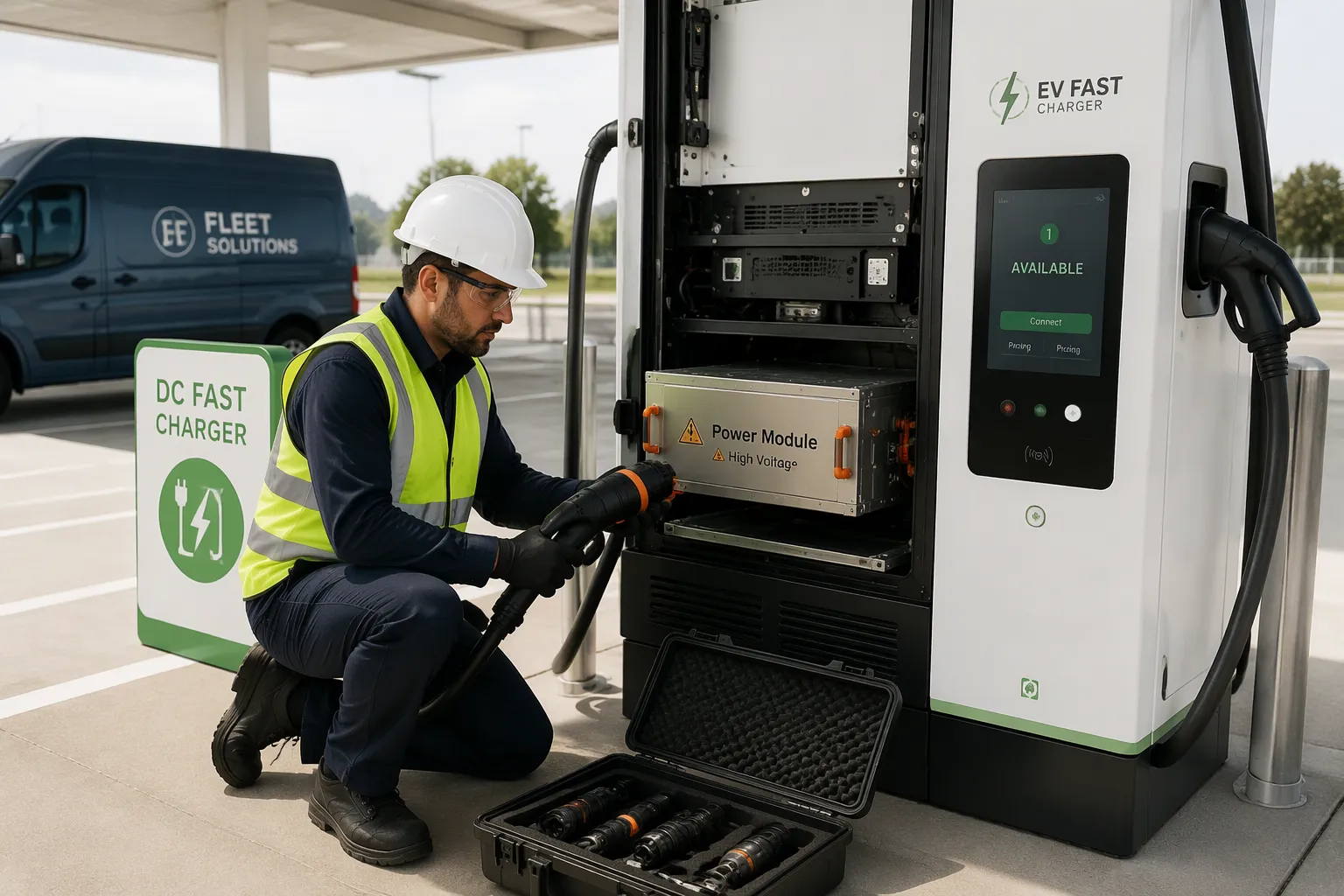
Service access is built into the hardware. Cable assemblies and connector kits are made to be replaced at the site, so a technician can install a new cable or plug without removing the dispenser. The power modules sit in sealed enclosures that can be serviced as whole units. A failed module comes out and a spare goes in, and the rest of the charger keeps working. Procurement teams should check local stock for cable assemblies and connector kits before a rollout. A replaceable part only cuts downtime when a spare is ready.
Performance, Compliance, and Fit
The platform falls in the high-power DC classes. Buyers should ask for the power curve for each model and check how output holds up during a long charging session. Cable reach and dispenser mounting should be reviewed against the site layout. Corridor sites exposed to weather call for a look at the tested operating range and the cable jacket specification.
Compliance coverage includes UL listing for North America, CE marking for Europe, and OCPP support for backend integration. Confirm the firmware version that carries each certification during procurement, and check that the OCPP level matches your network software.
Cost positioning is mid-to-premium. The purchase price sits below the top tier, and the case rests on sealed serviceable modules and parts availability. Ask each finalist for a five-year parts quote and typical lead times. Tritium fits best where a corridor or fleet site needs high-power DC charging and a service model built around module and cable swaps.
BTC Power
Product Lines and Field-Replaceable Design
BTC Power makes AC and DC chargers for fleet and public charging. The lineup covers AC units through high-power DC classes. One vendor family can serve a mixed site, which makes spare-parts planning and technician training simpler across a network.
Service access shapes how the hardware is built. Connector and cable spares are kept as replaceable parts. A technician takes off a worn plug or damaged cable at the dispenser and fits a spare on the same visit. Replaceable sub-assemblies bring the same idea to internal components. A failed sub-assembly comes out as a unit, and the rest of the charger stays in service. Procurement teams should check local stock levels and typical lead times for these parts before a rollout. A replaceable part only cuts downtime when a spare is ready nearby.
Performance, Compliance, and Fit
The platform spans AC through high DC power classes. Buyers should ask for the power curve for each model and check how output holds through a long session. Cable reach and mounting options should be reviewed against the site layout. Outdoor fleet yards call for a look at the tested operating range and the cable jacket specification.
Compliance coverage includes UL listing and OCPP support for backend integration. Confirm the firmware version that carries each certification during procurement. Check that the OCPP level matches your network software, because backend compatibility protects the investment in management systems.
Cost positioning is value-to-mid. The purchase price sits at or below mid-range platforms, and the case rests on affordable spares and replaceable sub-assemblies. Ask each finalist for a five-year parts quote and typical lead times. BTC Power fits best where a fleet or public network needs AC and DC charging on a controlled budget, with a service model built around connector, cable, and sub-assembly swaps.
Matching Manufacturers to Use Cases
Highway Corridors and High-Power Hubs
Highway sites need strong power that lasts through a long charge. They also need spare cables and connectors close by. Alpitronic fits this well. Its satellite dispenser keeps the power cabinet off the curb, which helps when bay space is tight. Tritium also works for corridors, with sealed power modules that swap as whole units and UL and CE coverage for both major markets. ABB E-mobility offers the widest platform and the deepest service for operators who run corridor hubs alongside other site types.
Buyers should pick two or three of these makers and ask for the power curve for each model. Compare how output holds late in a session, not just at peak. Ask about local stock of cable assemblies and connector kits, plus normal lead times. A high-power unit with a faraway spare-parts warehouse will still sit idle after a failure.
Fleets, Workplaces, and Urban Networks
Depot and workplace sites often grow one stall at a time, so modular systems pay off. Kempower fits here, with power cabinets that feed several dispensers and plug-and-cable kits for on-site repair. BTC Power serves mixed AC and DC sites on a set budget, with replaceable sub-assemblies that keep the rest of the charger running. ABB E-mobility covers workplace AC wallboxes through DC units under one vendor family, which makes training and parts planning simpler.
Urban networks should weigh OCPP support and firmware versions when making the shortlist. Confirm the certification level for each market and check that the backend software matches. Ask each finalist for a five-year parts quote. Compare consumable pricing and lead times side by side, then weigh that number against the value of uptime at each site.
ABB E-mobility stands out for its wide range of platforms and compliance in both major markets. Alpitronic and Tritium stand out for high-power performance on highway corridors. Kempower stands out for modular fit at depots, and BTC Power stands out for cost. These are the best manufacturers for charging networks when each one is matched to its site.
Use case | Best fit |
|---|---|
Highway fast charging | Alpitronic, Tritium |
Fleet depots | Kempower |
Workplace and urban networks | ABB E-mobility, Kempower |
Budget-sensitive rollouts | BTC Power |
Before you sign, confirm three things. Ask for the field-replaceable parts list in writing. Check local spare stock and lead times. Match every certification to your target market and firmware version.
FAQ
What makes a charging network manufacturer trustworthy?
Look for three proofs. The maker publishes a list of parts that can be replaced on site. Spare connectors and cables are kept in local stock with short wait times. Certifications match your target market and the firmware version you will run. A trusted maker puts all three in writing before you sign.
Which parts should operators keep on hand?
Stock the parts that fail most often: connectors, cables, and contactor assemblies. Add power modules for modular platforms. Confirm part numbers and lead times with the manufacturer first. A part sitting in a faraway warehouse does little for a site that is down.
How do I verify field-replaceable design during procurement?
Ask for the service manual and the parts list in writing. Request a demonstration of a connector or cable swap. Check warranty terms on replaceable components. Confirm that a swap does not require removing the whole dispenser.
Where does DUOSIDA fit in a charging network?
DUOSIDA builds charging connection devices and connector assemblies in-house. Its certifications include UL, CSA, TUV, BS, CE, PSE, and 16949. The company fits value-to-mid budgets and supplies car companies and charging pile makers in China, Europe, and America.
Does a premium platform always cost more over its life?
No. Total cost of ownership depends on parts pricing, lead times, and uptime. A premium unit with cheap, fast-sourced spares can beat a lower-priced unit with slow, costly parts. Ask each finalist for a five-year parts quote and compare.