
CCS1 vs CCS2 EV Charging Sockets: Key Differences Explained
 2026-08-20

As electric vehicle adoption expands across different regions, charging connector standards have become an important consideration for EV manufacturers, charging station developers, fleet operators, and infrastructure integrators. Among the most widely recognized DC fast-charging standards are CCS1 and CCS2. Although both are based on the Combined Charging System, they are designed for different regional charging ecosystems and vehicle platforms.
For companies sourcing EV charging components from China, understanding the practical differences between CCS1 and CCS2 is essential. The right vehicle inlet needs to match the vehicle platform, charging infrastructure, electrical requirements, installation method, and target market.
Zhangjiagang UCHEN New Energy Technology Co., Ltd., also known as Youcheng Technology, is a China-based charging solution provider focused on the development and market promotion of high-performance charging products for new energy vehicles. Through its DUOSIDA brand, the company provides a broad range of EV charging components for different charging standards and applications.
CCS1 and CCS2: The Basic Difference
CCS1 and CCS2 are both Combined Charging System interfaces. The key difference is the AC connector portion incorporated into the vehicle inlet.
CCS1 is commonly associated with the North American charging market. It combines the AC Type 1 interface with two additional DC power contacts for fast charging. This configuration provides a compact solution for vehicles designed around the Type 1 charging ecosystem.
CCS2, on the other hand, is based on the Type 2 AC interface and adds two DC contacts underneath. It is widely used in European and many international EV markets. The larger AC contact configuration of Type 2 also supports three-phase AC charging, making CCS2 suitable for a broader range of charging applications.
For manufacturers developing vehicles for international markets, this distinction affects more than the shape of the socket. It can influence the vehicle's charging architecture, wiring, control system, mechanical design, and certification requirements.
Why CCS1 Is Important for North American EV Applications
CCS1 remains an important charging interface for EVs developed for markets using the SAE J1772-based Type 1 charging system.
For vehicle manufacturers and charging equipment developers targeting these markets, a CCS1 vehicle inlet provides a combined interface for AC and DC charging. This allows a single vehicle-side socket to support both conventional AC charging and higher-power DC charging.
DUOSIDA's CCS1 Vehicle Inlet range includes models designed for different DC input requirements, including 80A, 150A, and 200A configurations. The product range is therefore relevant for EV manufacturers and charging system integrators that need to select a vehicle inlet according to their electrical architecture.
When choosing a CCS1 inlet, buyers should look beyond the connector shape. Rated current, voltage capability, thermal performance, mechanical durability, insulation, sealing, and installation structure all need to be considered.
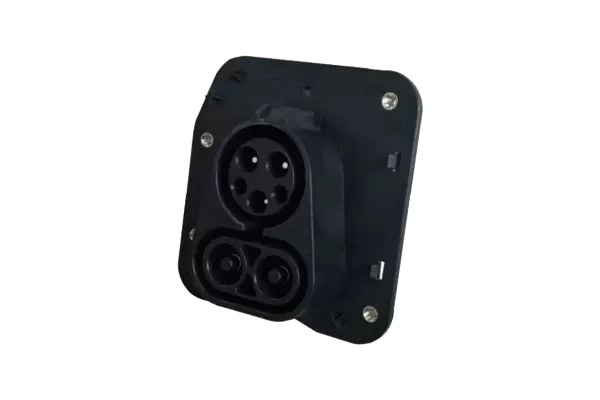
For businesses developing vehicles or charging systems for the North American market, the CCS1 EV Vehicle Inlet product can be evaluated as part of the vehicle-side charging system.
Why CCS2 Has Become a Major Global Charging Standard
CCS2 has a particularly strong position in Europe and many international EV markets. Its Type 2-based AC section allows the same vehicle inlet to accommodate both AC and DC charging functions.
For EV manufacturers serving multiple markets, CCS2 can also simplify product planning when the target regions use the Type 2 charging ecosystem.
DUOSIDA's CCS2 Vehicle Inlet is designed for rear installation and provides IP55 protection under working conditions. The product is manufactured with a flame-retardant UL94 V-0 thermoplastic housing, while the copper-alloy pins use silver plating. Its published operating temperature range is -30°C to +50°C.
The electrical configuration includes DC input options of 80A, 125A, 150A, and 200A at 1000VDC. Depending on the selected configuration, the inlet can also accommodate AC input options including 16A, 32A, and 63A.
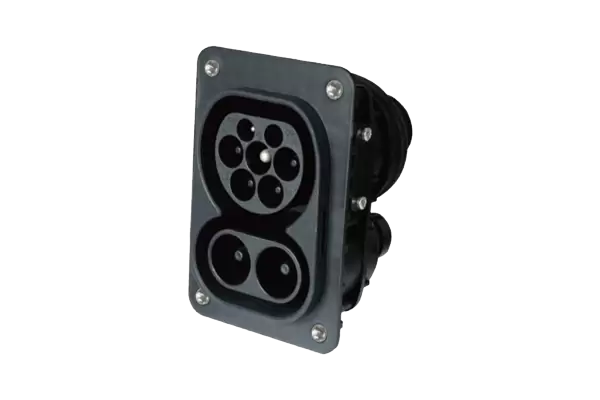
These specifications show why CCS2 selection should be treated as an engineering decision rather than simply choosing a connector based on appearance.
CCS1 vs CCS2: What Should Buyers Compare?
For B2B buyers, the most useful way to compare CCS1 and CCS2 is to evaluate the complete application.
1. Target Market
The first question is where the vehicle or charging equipment will be deployed.
CCS1 is primarily associated with North American charging systems, while CCS2 is widely used across Europe and other international markets. Selecting the wrong interface can create compatibility problems between the vehicle and local charging infrastructure.
2. AC Charging Configuration
The AC portion is one of the most visible differences between the two standards.
CCS1 uses a Type 1-based AC interface, while CCS2 uses Type 2. For vehicle manufacturers that need three-phase AC charging capability, the CCS2 architecture can provide a more suitable platform.
3. DC Charging Requirements
Rated DC current is another major consideration.
A vehicle platform designed for higher-power DC charging requires an inlet, cable, terminals, and thermal management system capable of handling the intended electrical load. DUOSIDA's CCS2 range, for example, provides 80A, 125A, 150A, and 200A DC input configurations with a 1000VDC rating.
Rather than selecting the highest-rated component automatically, manufacturers should match the inlet to the actual charging architecture and vehicle requirements.
4. Mechanical Installation
Vehicle inlets are installed directly into the vehicle body, so installation space and mounting structure matter.
DUOSIDA's CCS2 Vehicle Inlet uses a rear-installation configuration. Mechanical specifications such as insertion force and durability can also affect long-term usability. The published CCS2 specification lists a no-load plug-in/withdrawal mechanical lifespan of more than 10,000 cycles and a coupled insertion force below 140N.
These details are particularly relevant for commercial vehicles and charging systems that may experience frequent connection and disconnection.
5. Environmental Protection
Charging sockets are exposed to outdoor environments, moisture, dust, temperature changes, and repeated mechanical operation.
IP protection should therefore be considered during product selection. The DUOSIDA CCS2 Vehicle Inlet is specified at IP55 under working conditions, with an operating temperature range of -30°C to +50°C.
For an EV manufacturer, these specifications need to be evaluated together with the vehicle's enclosure design and installation environment.
Beyond CCS1 and CCS2: Building a Complete Charging Product Portfolio
A charging connector manufacturer serving global markets needs to provide more than one interface standard. Different vehicles and charging infrastructures require different connector solutions.
DUOSIDA's product portfolio covers multiple EV charging categories, including Charging Socket, Charging Plug, Charging Mode 2, Charging Mode 3, HPC Products, NACS Products, adapters, electric locks, charging stations, connector holders, and high-voltage connector products. Its product platform also includes European, Japanese, China National, American, Thai, and Australian standard categories.
This broader portfolio is useful for OEMs and charging infrastructure companies that need to source multiple components from one experienced supplier rather than managing separate suppliers for every charging standard.
For a full overview of available vehicle inlets and charging socket solutions, buyers can visit the DUOSIDA Charging Socket product range.
What Makes a Reliable China EV Charging Connector Manufacturer?
For international buyers, choosing a supplier is not only about the connector itself. Consistent manufacturing, technical support, product documentation, quality control, and the ability to support different standards are equally important.
Zhangjiagang UCHEN New Energy Technology Co., Ltd. positions itself as a charging solution service provider in China, focusing on high-performance charging products for new energy vehicles. Its DUOSIDA product portfolio demonstrates a multi-standard approach, covering charging sockets and other components for different EV charging applications.
For OEM and project-based buyers, this approach can be valuable because the charging system often includes several interconnected components. A supplier that understands vehicle inlets, charging plugs, sockets, adapters, locks, and related high-voltage components can provide more practical support during product development and sourcing.
Choosing CCS1 or CCS2 for Your Next EV Project
There is no universal answer to whether CCS1 or CCS2 is better. The appropriate choice depends primarily on the target market and vehicle charging architecture.
If the vehicle is intended for a North American Type 1 charging ecosystem, CCS1 is generally the relevant combined charging interface. If the vehicle is designed for markets based on Type 2 charging infrastructure, CCS2 is the more appropriate option.
However, the connector standard is only the starting point. Engineers and procurement teams should also evaluate rated current, voltage, AC/DC configuration, installation method, environmental protection, mechanical lifespan, materials, electrical safety, and applicable standards.
For companies looking for a China EV charging connector holder and charging component manufacturer for global markets, DUOSIDA provides a broader product platform that can support different charging standards and EV applications. Explore the DUOSIDA official website to learn more about its charging products and solutions.
Conclusion
CCS1 and CCS2 serve the same fundamental purpose but belong to different charging ecosystems. CCS1 is closely connected with Type 1-based charging infrastructure, while CCS2 combines the Type 2 AC interface with DC fast-charging contacts and is widely used in Europe and other international markets.
For EV manufacturers, charging station developers, and international distributors, selecting the right vehicle inlet requires a detailed understanding of electrical, mechanical, environmental, and regional requirements.
By offering CCS1, CCS2, and a wider range of EV charging components, DUOSIDA provides a practical product portfolio for businesses developing charging equipment and new energy vehicle applications for different global markets.