
China EV Charging Connector Holder Manufacturer for Global Markets
 2026-08-19

As EV charging infrastructure expands across Europe, North America, Asia, and other markets, charging equipment manufacturers are paying more attention to components that are often overlooked during the early stages of product design.
The connector holder is one of them.
A charging connector holder does not transfer electricity or control the charging process, but it provides a practical place to store and secure the connector when it is not being used. In a commercial charging environment, this simple function can affect how the charging equipment is operated, maintained, and protected over time.
For B2B buyers, the question is therefore not simply where to purchase a plastic or metal holder. The more important question is whether the supplier understands EV charging equipment, can provide a suitable mechanical solution, and can maintain consistent production for long-term orders.
Zhangjiagang UCHEN New Energy Technology Co., Ltd., also known as Youcheng Technology, focuses on the development and market promotion of high-performance charging products for new energy vehicles. Its DUOSIDA product portfolio includes Connector Holder as well as charging plugs, charging sockets, charging stations, electric locks, high-voltage connector products, and other EV charging components.
Why a Connector Holder Matters in an EV Charging System
An EV charging connector is designed to handle repeated connection and disconnection. When it is not connected to a vehicle, however, it still needs a suitable storage position.
Simply leaving a charging connector hanging from the charging cable or placing it on a nearby surface is not always a practical solution.
A dedicated connector holder can provide a defined location for the connector and help organize the charging equipment.
This becomes particularly useful in:
- Public EV charging stations
- Commercial parking facilities
- Workplace charging areas
- Fleet charging facilities
- Residential charging installations
- EV charging equipment used outdoors
- Charging equipment integrated into larger electrical systems
For charging station manufacturers, the holder is part of the physical user interface. The connector should be easy to access when charging begins and easy to return to its designated position after charging is complete.
From Accessory to Part of the Charging Equipment
One reason connector holders deserve more attention is that they interact directly with the way users operate a charging station.
Consider a public charging station.
A driver arrives, removes the connector, connects it to the vehicle, completes the charging session, and then returns the connector to the station.
If the holder is difficult to use, does not retain the connector properly, or is poorly positioned, the charging experience becomes less convenient.
A well-matched holder should support three basic actions:
Remove: The user should be able to take the connector out without unnecessary effort.
Use: The connector should remain connected to the vehicle during the charging session.
Return: After charging, the connector should have a clear and stable storage position.
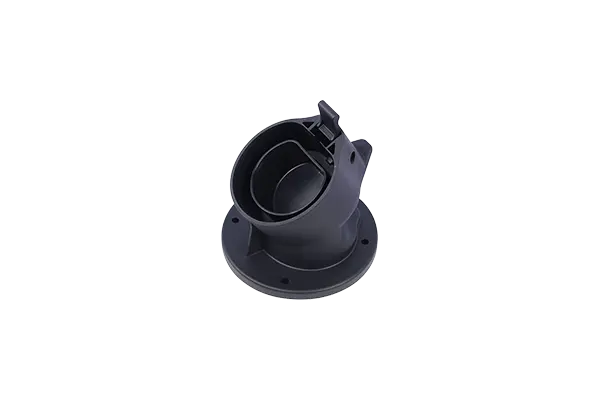
These details may seem minor during product development, but they become much more noticeable when equipment is installed at hundreds or thousands of charging points.
Why China Is an Important Source for EV Charging Components
China has developed a broad supply chain for electric vehicle charging equipment.
The supply base covers charging connectors, charging sockets, charging stations, charging cables, high-voltage components, electrical locks, adapters, and other supporting components.
For international buyers, this means a connector holder can potentially be sourced from the same type of specialized manufacturing ecosystem as other EV charging components.
However, buyers should distinguish between a general hardware supplier and a manufacturer with actual EV charging product experience.
A specialized supplier is more likely to understand how the holder needs to work with the connector, charging station housing, cable arrangement, and installation environment.
That experience can become particularly useful when the customer needs a customized holder rather than a generic mounting bracket.
What Should a B2B Buyer Look for in a Connector Holder?
A connector holder should be evaluated according to the charging equipment in which it will be installed.
There is no single design that is automatically suitable for every charging station.
1. Connector Compatibility
The first consideration is the connector that will be stored.
The holder should be designed around the relevant connector's dimensions, shape, locking structure, and insertion direction.
A holder intended for one connector configuration should not automatically be assumed to fit another.
This is particularly important for manufacturers working with different charging standards.
2. Mechanical Retention
The holder should keep the connector properly positioned when it is stored.
A loose connection can allow the charging gun to move or fall, while an excessively tight holder can make daily operation inconvenient.
The right balance depends on the connector design and intended installation.
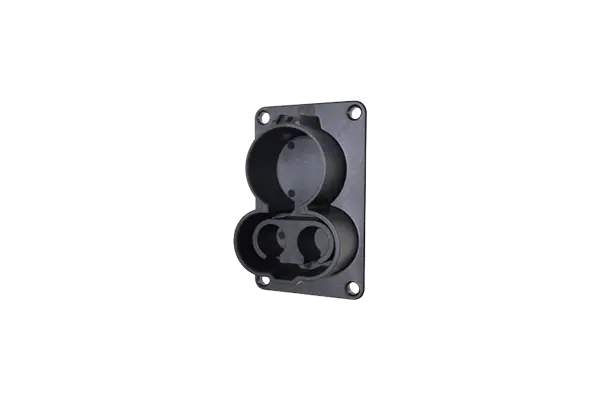
3. Installation Method
The installation structure needs to match the charging station or mounting surface.
Depending on the project, buyers may need to consider:
- Mounting holes
- Screw positions
- Installation direction
- Available space
- Housing structure
- Wall or pedestal installation
- Cable routing
These details should be confirmed before production.
4. Material and Environmental Conditions
Charging stations may be installed indoors or outdoors.
Outdoor equipment can be exposed to rain, dust, sunlight, temperature changes, and repeated user operation.
The material selection of the holder should therefore be appropriate for its intended environment.
For an international B2B project, the buyer should provide the factory with information about the installation environment rather than selecting a product based only on appearance.
Connector Holders for European EV Charging Equipment
European charging infrastructure includes a wide range of AC and DC charging equipment, with Type 2 and CCS2 among the important connector configurations used in the market.
A connector holder for European charging equipment should therefore be evaluated according to the actual connector model.
The DUOSIDA product structure is designed around multiple EV charging categories and standards. Its website lists European Standard, Japanese Standard, China National Standard, American Standard, Thai Standard, and Australian Standard categories within its broader product system.
For European buyers, this broader product experience can be useful when the holder needs to be integrated with other charging components.
Instead of treating the holder as a separate generic accessory, it can be evaluated as part of the complete charging equipment design.
Public Charging Requires More Attention to Mechanical Design
Public charging stations are different from many residential charging systems.
A public unit can be used repeatedly by different people who have different operating habits.
The connector may be pulled out quickly, returned at different angles, or handled more frequently than expected during the original product design.
This means the connector holder should be able to support practical daily use.
For commercial charging equipment, manufacturers should consider:
- Repeated insertion and removal
- Connector weight
- Cable tension
- Mounting strength
- User access
- Outdoor exposure
- Cleaning and maintenance
- Long-term mechanical performance
A holder that works well in a prototype may still need additional evaluation before it is used in high-frequency commercial charging equipment.
The Importance of Factory Manufacturing Capability
For B2B buyers, the biggest difference between suppliers often appears after the sample stage.
A sample can be acceptable while mass-produced parts vary in dimensions, surface finish, material characteristics, or assembly quality.
This is why the manufacturing process matters.
A capable China EV charging component factory should have defined procedures for:
Material control: Incoming materials should meet the agreed requirements.
Production control: Manufacturing processes should follow consistent procedures.
Dimensional inspection: Critical dimensions should be checked during production.
Functional inspection: The holder should be checked with the intended connector where appropriate.
Final inspection: Finished products should be reviewed before shipment.
For long-term customers, batch consistency is especially important because the connector holder may be integrated directly into the customer's charging equipment.
Why Working With an EV Charging Manufacturer Can Be More Practical
A general plastic or hardware supplier may be able to produce a holder based on a drawing.
However, an EV charging manufacturer can provide additional application knowledge.
The holder may need to work alongside:
- Charging plugs
- Charging sockets
- Charging cables
- Electric locks
- Charging stations
- Vehicle interfaces
- Other EV charging components
Youcheng Technology focuses specifically on high-performance charging products for new energy vehicles. DUOSIDA's product portfolio includes Charging Socket, Charging Plug, Charging Mode 2, Charging Mode 3, HPC Products, NACS Products, Electrical Discharge Products, Vehicle Outlet Socket, Adapter, Electric Lock, Charging Station, Connector Holder, and High Voltage Connector Products.
This broader product coverage means customers can evaluate the connector holder within a larger EV charging product ecosystem.
OEM Connector Holder Solutions
Not every charging station uses the same housing design.
Some customers may have a standard charging cabinet. Others may be developing a proprietary charger with their own housing, connector position, and cable management system.
In these cases, an OEM or customized connector holder may be required.
Potential customization requirements can include:
- Mounting dimensions
- Hole position
- Holder geometry
- Connector fit
- Installation direction
- Material requirements
- Surface treatment
- Product labeling
- Packaging
- Private branding
The actual customization scope should be confirmed through engineering review.
For a manufacturer, it is preferable to receive the customer's connector drawings, housing dimensions, and installation requirements before preparing a production sample.
This reduces the risk of developing a holder that looks correct but does not integrate properly with the final charging equipment.
Connector Holder and Cable Management
A connector holder should also be considered together with cable management.
A charging cable can be relatively heavy, especially in higher-current charging applications.
If the cable is allowed to hang freely, the weight and movement of the cable can place additional stress on the connector and its mounting area.
A properly positioned holder can help create a more organized charging interface.
For charging station designers, this means the location of the holder should be considered alongside:
- Cable length
- Connector weight
- Cable bending direction
- Connector insertion angle
- Station height
- User access
- Housing structure
These are practical design details that can influence how the charging station performs in everyday use.
Why Product Consistency Matters for International Distributors
Distributors often purchase components repeatedly and supply them to different charging equipment manufacturers or installation projects.
If the same product changes slightly between batches, it can create problems for downstream assembly.
For example, a small dimensional change may affect how the holder fits into a charging station housing.
Consistent manufacturing therefore helps distributors maintain stable product specifications.
For this reason, buyers should ask potential suppliers about:
- Production process control
- Inspection procedures
- Sample approval
- Batch management
- Quality documentation
- Production capacity
- OEM support
A long-term supplier relationship should be based on repeatable production rather than one successful sample.
How to Evaluate a China Connector Holder Supplier
A practical evaluation can start with five questions.
Does the supplier understand EV charging?
A supplier familiar with EV charging connectors is more likely to understand the actual application.
Can the supplier provide technical information?
Drawings, dimensions, materials, and installation information should be available when required.
Can the product be customized?
For OEM charging equipment, customization may be necessary.
Does the factory control quality?
The supplier should have clear production and inspection procedures.
Can it support repeat orders?
The supplier needs sufficient production capability for long-term B2B cooperation.
These questions can help buyers move beyond catalog-based supplier selection.
More Than a Standalone Accessory
A connector holder may be one of the smallest visible parts of an EV charging station, but it contributes to the overall design of the equipment.
When correctly selected, it provides a designated storage position, supports practical connector handling, and helps keep the charging interface organized.
For charging equipment manufacturers, the best solution is usually one that is considered during the equipment design stage rather than added after the main product has already been finalized.
For distributors, choosing a holder from a specialized EV charging manufacturer can also simplify product sourcing when other charging components are required.
The DUOSIDA Connector Holder product category provides the starting point for customers looking for connector holder solutions for EV charging applications.
DUOSIDA as a China EV Charging Product Manufacturer
Zhangjiagang UCHEN New Energy Technology Co., Ltd. is focused on the development and market promotion of high-performance charging products for new energy vehicles.
Rather than supplying only one type of charging accessory, DUOSIDA has built a broader product portfolio covering multiple parts of the EV charging system.
For customers purchasing connector holders together with charging plugs, sockets, charging stations, electric locks, or other components, this can make technical communication and supplier management more straightforward.
The DUOSIDA official website provides additional information about its EV charging products and solutions.
For international customers, the benefit of working with a specialized EV charging manufacturer is not limited to the component itself. It also includes the manufacturer's understanding of charging applications, production requirements, and the practical issues involved in integrating different components.
Final Considerations for Global Buyers
A connector holder does not need to be complicated, but it does need to be appropriate for the charging equipment.
Before placing a B2B order, buyers should confirm:
- Which connector will be stored
- Whether the holder matches its dimensions
- How the holder will be installed
- Whether the charging station is indoor or outdoor
- How frequently the connector will be handled
- How the cable will be routed
- Whether customization is required
- What production and inspection standards the factory follows
- Whether the supplier can maintain consistent repeat production
For public and commercial charging equipment, these details become even more important because the product will be exposed to repeated use.
Conclusion
The growth of EV charging infrastructure is creating demand not only for charging stations and connectors but also for the supporting components that make charging equipment practical to use.
A connector holder provides a designated location for storing the charging connector and can contribute to better equipment organization, connector handling, and overall station usability.
For B2B buyers, the right supplier should offer more than a standard holder. It should understand EV charging applications, provide suitable technical support, maintain production consistency, and have the ability to support OEM requirements when necessary.
China's EV charging supply chain provides international buyers with access to specialized manufacturing capabilities. For companies sourcing connector holders for global charging equipment, working with a manufacturer experienced in EV charging products can make product integration and long-term procurement more efficient.
Zhangjiagang UCHEN New Energy Technology Co., Ltd. and its DUOSIDA product portfolio provide a range of EV charging components, including Connector Holder, Charging Plug, Charging Socket, Charging Station, Electric Lock, and other products.
For a global B2B buyer, the practical approach is straightforward: start with the connector and charging station requirements, confirm the mechanical interface, evaluate the factory's manufacturing capability, test the product, and then establish specifications for repeat production.
A reliable connector holder is a small component, but selecting the right manufacturer can make a meaningful difference to the quality and consistency of the complete EV charging product.