
Liquid-Cooled HPC Charging Connectors: How They Enable Faster EV Charging
 2026-09-09

As electric vehicles become more capable of accepting high charging power, charging infrastructure is facing a practical engineering challenge: how to deliver more current without making the charging connector excessively large, heavy, or difficult to handle.
This is where liquid-cooled HPC charging connectors become increasingly important.
High Power Charging (HPC) systems are designed for much higher current levels than conventional DC charging equipment. As current increases, heat generated in conductive components and cable assemblies also becomes a major consideration. Liquid cooling provides a way to manage this heat while keeping the charging equipment suitable for real-world use.
For EV charging station manufacturers, fleet charging operators, system integrators, and other businesses sourcing high-power charging components, understanding this technology is important when selecting the right connector.
Why High-Power Charging Creates a Thermal Challenge
The basic principle is straightforward: higher charging power generally requires higher voltage, higher current, or a combination of both.
However, increasing current creates additional heat in conductive components. If heat is not effectively controlled, it can affect charging performance, component durability, connector safety, and the overall design of the charging system.
Traditional air-cooled cables can become increasingly difficult to manage as current requirements rise. A larger conductor can help reduce resistance, but it also makes the cable heavier and less convenient for users.
For HPC charging, the engineering objective is therefore not simply to increase the current rating. The charging connector must also provide an effective method of managing heat during continuous operation.
Liquid cooling addresses this problem by circulating coolant through dedicated cooling channels in the charging cable or connector assembly. The heat generated during high-current charging can then be transferred away from the critical components.
This makes liquid-cooled technology particularly suitable for high-power DC charging applications.
How a Liquid-Cooled HPC Charging Connector Works
A liquid-cooled charging connector combines the electrical function of a high-current connector with a thermal management system.
During charging, current passes through the conductive contacts and cable conductors. Heat is naturally generated as electrical current flows through components with electrical resistance.
In a liquid-cooled design, coolant circulates through the designated cooling path. The cooling system absorbs heat from the high-temperature areas and transfers it away from the connector and cable assembly.
The benefit is not simply “more cooling.” The real advantage is that thermal management can be integrated into the charging system without requiring the entire cable to become excessively large.
This is especially valuable when the charging system is designed for high current levels such as 500A, 600A, or 800A.
For infrastructure developers, this means the connector can be designed around both electrical performance and practical handling requirements rather than focusing on current capacity alone.
From 500A to 800A: Why Current Rating Matters
Current rating is one of the first specifications that B2B buyers should examine when evaluating HPC charging connectors.
Different charging projects have different power requirements. A passenger EV charging site may have different requirements from a commercial fleet depot, electric bus facility, or heavy-duty vehicle charging project.
DUOSIDA's current HPC product portfolio illustrates this range.
The company's HPC category includes liquid-cooled products with different current configurations, including 400A, 500A, 600A, and 800A solutions. The category also includes a CCS1 liquid-cooled product with a maximum constant current of 500A. Some of its HPC products are specified for 1500V/DC operation, while another 600A product is rated at 1000V.
This range is useful because it gives charging equipment developers more flexibility when matching the connector to the electrical architecture of a project.
For example:
| Application requirement | Important connector consideration |
|---|---|
| High-power passenger EV charging | Current rating and thermal management |
| Fleet charging | Continuous charging performance |
| Commercial vehicles | Higher current and robust construction |
| Ultra-high-power charging | Current, voltage and cooling system compatibility |
| North American charging projects | Appropriate connector standard and electrical rating |
The correct selection should always be based on the complete charging system rather than the connector's current rating alone.
Why 1500V Matters for Next-Generation HPC
Current and voltage work together to determine electrical power. Increasing voltage provides another way to achieve higher charging power without relying solely on extremely high current.
This is one reason 1500V-class charging components are attracting attention in high-power charging applications.
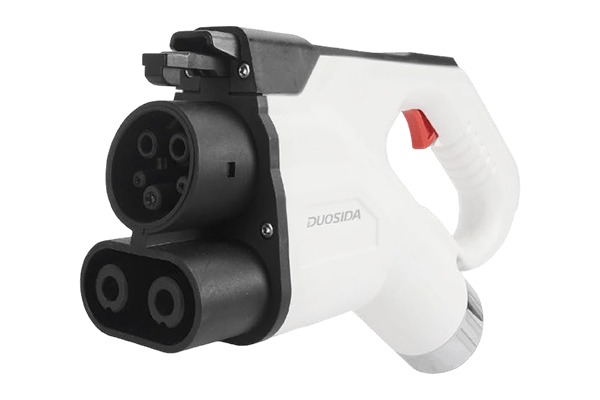
DUOSIDA's HPC portfolio includes several liquid-cooled products rated at 1500V/DC. Its CHAOJI DC vehicle connector, for example, is listed with a maximum constant current of 600A and an electrical performance rating of 600A/1500V DC. Other HPC products are listed at 600A/800A and 1500V/DC.
For charging system developers, these specifications provide room to design high-power architectures around both voltage and current requirements.
However, a higher voltage rating does not automatically mean that a charging connector is suitable for every project. The complete system still needs to be evaluated, including the vehicle inlet, charging station, cable assembly, cooling equipment, control system, and applicable charging standard.
Liquid Cooling Is About More Than Charging Speed
It is tempting to associate liquid-cooled HPC connectors only with faster charging. In practice, their value is broader.
A well-designed thermal management system can help maintain more stable operating conditions during high-current charging. This becomes particularly relevant when a charging station is used repeatedly throughout the day.
Consider a fleet depot where multiple vehicles return to charge during concentrated operating periods. The charging connector may experience repeated high-current charging cycles rather than occasional use.
In such an environment, thermal management becomes part of the overall reliability strategy.
For operators and equipment manufacturers, the practical questions are therefore:
- Can the connector support the required current?
- Can the cooling system remove heat effectively?
- Is the cable manageable for operators?
- Does the connector match the vehicle inlet?
- Does the product meet the required charging standard?
- Is the component suitable for the intended duty cycle?
These questions are more useful than evaluating a connector based on maximum current alone.
CHAOJI and CCS1 Options for Different Markets
Another important consideration for international EV charging projects is connector standardization.
Charging infrastructure is not built around a single global connector format. Different markets and vehicle platforms use different standards, so manufacturers and system integrators need to select components compatible with their target market.
DUOSIDA's HPC product category covers several standards, including European, Japanese, China National, American, Thai, and Australian standards.
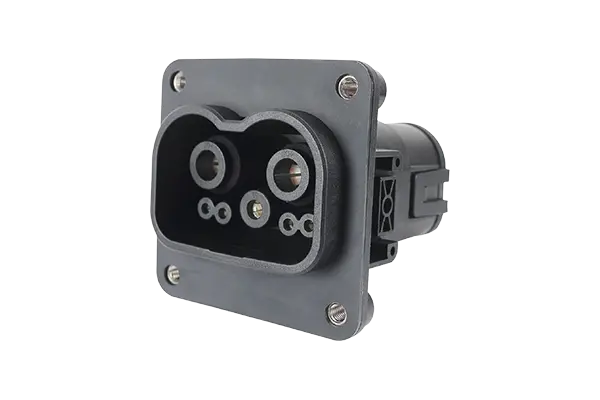
The current HPC portfolio also includes CHAOJI DC vehicle inlet and CHAOJI DC vehicle connector products, as well as CCS1 liquid-cooled products. This gives international customers options when developing charging equipment for different vehicle and infrastructure requirements.
For an OEM or charging equipment manufacturer, this multi-standard product coverage can simplify sourcing because connector selection can be coordinated with the intended market and vehicle platform.
What Should B2B Buyers Check Before Selecting an HPC Connector?
When sourcing liquid-cooled HPC connectors, it is better to create a technical checklist before comparing suppliers.
1. Current and voltage requirements
Start with the actual electrical requirements of the charging system. Do not select an 800A connector simply because it has a higher rating. The connector should match the system architecture and intended charging duty.
2. Cooling configuration
Understand how the liquid cooling system is integrated into the connector and cable assembly. Cooling performance should be considered together with the charging station's thermal management system.
3. Connector standard
Confirm whether the project requires CCS1, CHAOJI, or another regional standard. Compatibility with the vehicle inlet is essential.
4. Vehicle-side compatibility
A charging connector is only one part of the charging interface. The vehicle inlet, electrical system, communication system, and mechanical interface all need to work together.
5. Operating environment
Outdoor charging stations may be exposed to temperature changes, dust, moisture, mechanical stress, and repeated use. The connector should be selected according to the actual installation environment.
6. Manufacturer capability
For large projects, supplier capability matters as much as the specification sheet. Buyers should consider engineering support, product range, customization capability, quality management, and after-sales communication.
DUOSIDA: High-Power Charging Products for Global EV Applications
Zhangjiagang UCHEN New Energy Technology Co., Ltd., also known as Youcheng Technology, is positioned as a charging solution service provider in China focused on the development and market promotion of high-performance charging products for new energy vehicles.
The company's product portfolio extends beyond HPC connectors. Its website covers charging sockets, charging plugs, Mode 2 and Mode 3 charging products, NACS products, electrical discharge products, vehicle outlet sockets, adapters, electric locks, charging stations, connector holders, and high-voltage connector products.
For customers working on high-power charging projects, this broader product range can be useful when multiple charging components need to be sourced from one specialized supplier.
DUOSIDA also presents high-level protection, ultra-fast charging, and safety certification as key areas of its charging product offering. Its website shows global service and manufacturing coverage and states that professional service is provided within 24 hours after receiving a business cooperation or product inquiry.
For more information about the company's charging product portfolio, visit the DUOSIDA EV official website.
For customers specifically looking for high-current liquid-cooled charging components, the HPC Products category provides the current product range, including 1500V/DC HPC products, 600A and 800A solutions, CHAOJI products, and CCS1 liquid-cooled products.
Conclusion
Liquid-cooled HPC charging connectors are becoming an important component of high-power EV charging infrastructure because they address one of the key engineering limitations of high-current charging: heat.
Instead of simply increasing conductor size, liquid cooling provides a more practical approach to managing heat while supporting high current levels. This makes the technology relevant to high-power charging stations, commercial fleets, heavy-duty EV applications, and other charging environments where charging capacity and repeated operation are important.
For B2B buyers, the right HPC connector should be selected according to current, voltage, cooling configuration, connector standard, vehicle compatibility, operating environment, and supplier capability.
With a portfolio covering liquid-cooled HPC products from 400A to 800A configurations, 1000V and 1500V/DC options, CHAOJI products, and CCS1 liquid-cooled solutions, DUOSIDA provides a practical product base for different high-power EV charging projects.