
High Voltage Connectors for EV Batteries, Motors and DC/DC Systems
 2026-09-21

As electric vehicles move toward higher voltage platforms and more compact electrical architectures, high voltage connectors are becoming an increasingly important part of the vehicle power system. They provide the physical and electrical connection between major high-voltage components while also needing to withstand vibration, temperature changes, moisture, and repeated service requirements.
In practical EV applications, high voltage connectors can be found around the battery box, motor driver, DC/DC system, high-voltage control equipment, and other power-related components. Their job is straightforward in principle: establish a stable connection. The engineering requirements behind that connection, however, can be much more demanding.
Zhangjiagang UCHEN New Energy Technology Co., Ltd., also known as Youcheng Technology (stock code: 873087), is positioned as a first-class charging solution service provider in China, focusing on the development and market promotion of high-performance charging products for new energy vehicles. Through its DUOSIDA product portfolio, the company provides charging and high-voltage connection solutions for new energy vehicle applications.
1. High Voltage Connectors in EV Battery Boxes
The battery box is one of the most important locations for high voltage connections in an electric vehicle.
The battery system delivers electrical energy to other high-voltage components, so the connection between the battery and the vehicle's electrical architecture needs to be designed around voltage, current, cable size, insulation, shielding, environmental protection, and installation requirements.
For this type of application, the connector is not simply a plug-and-socket component. It becomes part of the overall battery connection system.
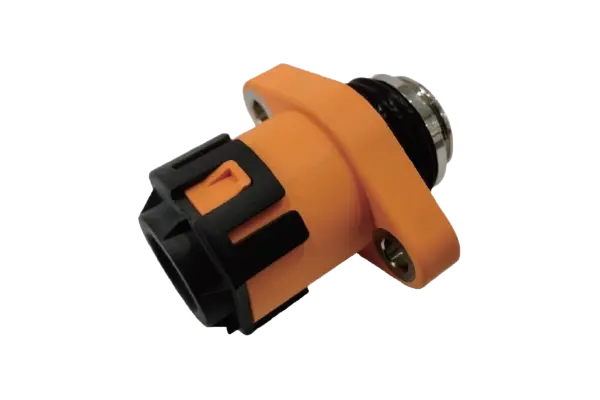
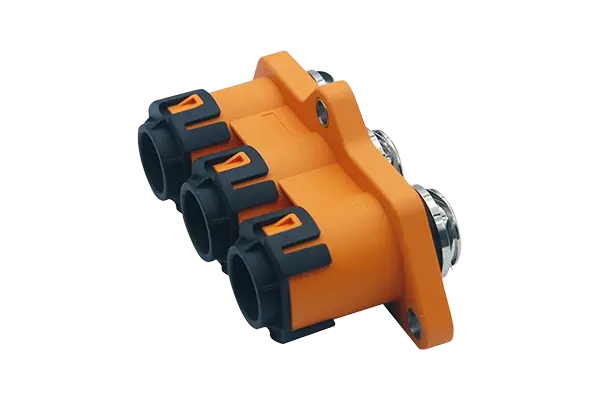
DUOSIDA's Two-Core Throughhole Connector is specifically listed for an electric vehicle battery box and motor driver. The product uses a plastic shell and has an IP67 protection rating. Its listed wiring range is 25mm²–50mm² shielded cable, with hexagonal cold crimping and screw locking.
Its electrical specifications include a rated voltage of 1000V DC and a maximum rated current of 200A. The product also lists insulation resistance above 1000MΩ, a 3000V AC insulation withstand voltage, temperature rise of no more than 50K, and 360° shielding effectiveness. Its operating temperature range is -40°C to +125°C.
For battery system designers, these parameters provide a practical starting point when matching the connector to the vehicle's high-voltage architecture.
2. One-Core and Two-Core Designs for Different Wiring Requirements
Not every high-voltage connection requires the same number of cores.
A one-core connector can be suitable when the electrical architecture calls for a single high-voltage connection path, while a two-core connector can be used where two conductors are required within the connection arrangement.
DUOSIDA provides both configurations within its high voltage connector range.
The One-Core Throughhole Connector is also designed for applications including electric vehicle battery boxes and motor drivers. Like the two-core version, it uses a plastic shell, provides IP67 protection, and supports 25mm²–50mm² shielded wiring.
Its listed electrical rating is 1000V DC and 200A maximum, with insulation resistance above 1000MΩ and a 3000V AC insulation withstand voltage. The connector also provides 360° shielding and is specified for operation from -40°C to +125°C.
The practical point for an engineering team is that connector selection should follow the actual circuit design rather than simply choosing the product with the highest electrical rating.
3. Motor Driver Connections Need a Different Perspective
The motor driver is another important high-voltage application.
In an EV powertrain, electrical energy from the battery must be delivered to the motor-related power electronics. The connection needs to remain stable under the mechanical and thermal conditions associated with vehicle operation.
This makes several factors particularly relevant:
Current-carrying capability
Cable compatibility
Mechanical locking
Insulation performance
Environmental sealing
Shielding
Installation space
Maintenance access
Both DUOSIDA's one-core and two-core through-hole connectors are listed for motor driver applications. Their screw-locking installation method provides a defined mechanical connection, while the shielded cable configuration and 360° shielding are relevant to high-voltage vehicle electrical systems.
For vehicle manufacturers and system integrators, this type of connector can therefore be considered as part of the complete motor power connection rather than as an isolated component.
4. Why Shielding Matters in High-Voltage Vehicle Systems
Shielding is easy to overlook when a connector is evaluated only from its voltage and current rating.
Modern EVs contain multiple electrical and electronic systems operating close to one another. High-voltage power circuits and control electronics need to coexist within a relatively compact vehicle architecture.
The two-core and one-core DUOSIDA through-hole connectors both specify 360° shielding effectiveness and are designed for shielded cable configurations from 25mm² to 50mm².
For an engineering project, this means cable, terminal, connector housing, and shielding should be evaluated as one connection assembly. Simply matching the connector's current rating to the electrical load is not enough.
5. DC/DC Systems: Connecting High-Voltage and Low-Voltage Architectures
DC/DC systems play an important role in EV electrical architecture because the vehicle may need to manage power between different voltage domains.
This creates another application area where high-voltage connectors need to be selected carefully.
The connection needs to fit the DC/DC equipment mechanically while meeting the electrical and environmental requirements of the system. Cable size, connector orientation, locking method, insulation, and protection against environmental exposure all need to be considered during integration.
When selecting a connector for a DC/DC application, engineers should therefore look at the complete installation rather than selecting a model based only on its maximum voltage.
This is also where having access to a broader high-voltage connector portfolio becomes useful. A connector supplier that offers different structures and configurations can make it easier to match individual connection points within the same vehicle platform.
6. Installation Design Can Affect Production Efficiency
For mass-produced EVs, connector installation is also a manufacturing issue.
A connector that performs well electrically but requires complicated installation can create additional assembly work. Conversely, a connector with a straightforward installation method can make production and maintenance more manageable.
The DUOSIDA one-core and two-core through-hole connectors use screw locking and hexagonal cold crimping. Both product pages describe the products as offering simple installation, reliable connection, and convenient disassembly.
Their model selections are also matched to different shielded cable sizes. The one-core version includes models for 25mm², 35mm², and 50mm² shielded cable, while the two-core version offers corresponding 25mm², 35mm², and 50mm² options.
For an OEM production line, this kind of configuration can be useful because cable specifications can be considered together with the connector model.
7. Environmental Protection Is Part of the Application
An EV connector may be installed in an environment exposed to water, dust, temperature variation, and vibration.
The protection rating therefore needs to match the actual location of the connector.
Both the one-core and two-core DUOSIDA through-hole connectors are listed with an IP67 protection rating and an operating temperature range of -40°C to +125°C.
These specifications are particularly relevant when the connector is integrated into a vehicle battery box or other areas where environmental exposure needs to be considered.
For project engineers, however, the final selection should still be based on the actual installation environment, vehicle design, and applicable testing requirements.
8. High Voltage Connectors Are Only One Part of the EV Electrical System
A connector does not work independently.
A typical high-voltage connection involves the connector, cable, terminal, power electronics, battery or electrical load, mechanical mounting structure, and protection system. A change to one component can affect the others.
This is why it can be useful to work with a supplier that understands a wider range of EV connection products.
The DUOSIDA High Voltage Connector Products category provides dedicated high-voltage connection solutions, while the wider DUOSIDA product portfolio includes Charging Socket, Charging Plug, Charging Mode 2, Charging Mode 3, HPC Products, NACS Products, Electrical Discharge Products, Vehicle Outlet Socket, Adapter, Electric Lock, Charging Station, Connector Holder, and High Voltage Connector Products.
This broader product coverage is relevant when an EV project involves multiple connection points rather than a single connector.
9. What Engineers Should Confirm Before Selecting a Connector
Before integrating a high-voltage connector into a battery, motor driver, or DC/DC system, it is useful to prepare a basic technical checklist:
Electrical
Rated voltage
Continuous and maximum current
Insulation resistance
Withstand voltage
Expected temperature rise
Mechanical
Cable cross-section
Number of cores
Locking method
Installation direction
Available installation space
Environmental
IP protection requirements
Operating temperature
Moisture and dust exposure
Vibration conditions
System
Battery or power electronics application
Shielding requirements
Service and maintenance requirements
Production assembly method
Having these details available before contacting a connector manufacturer can significantly reduce unnecessary back-and-forth during product selection.
10. Building the Connection Around the Vehicle Architecture
High-voltage connectors are small components, but their requirements are closely connected to the overall EV electrical architecture.
For battery boxes, the priority may be reliable high-voltage power transmission and environmental protection. For motor drivers, mechanical stability, cable compatibility, and shielding become important. For DC/DC systems, the connector needs to fit the equipment and the vehicle's power distribution architecture.
DUOSIDA's one-core and two-core through-hole connectors demonstrate how different connector configurations can address related EV applications while maintaining consistent considerations for voltage, current, shielding, cable size, installation, and environmental protection.
Zhangjiagang UCHEN New Energy Technology Co., Ltd. (Youcheng Technology, stock code: 873087) focuses on high-performance charging products for new energy vehicles. Through the DUOSIDA brand, its product portfolio extends from charging interfaces and HPC solutions to NACS products and high-voltage connection products.
For EV manufacturers, battery system developers, and electrical system integrators, the practical approach is to start with the actual connection point: where the connector will be installed, what cable it will use, what electrical load it must carry, and what environmental conditions it will face. From there, the appropriate high-voltage connector configuration can be evaluated against the complete vehicle system.