
Elbow Through Hole Metal Connector: Features and Applications
 2026-10-23

In electric vehicle electrical systems, connector selection is not only about voltage and current ratings. The direction of the cable, the available mounting space, and the arrangement of nearby components can also affect how easily a connection is integrated into the overall design.
An elbow through hole metal connector is worth considering when a project requires an angled connection and a mounting arrangement that passes through a panel or enclosure. Compared with a straight connector, its angled configuration may offer a different way to route cables in confined spaces. Whether it is the right choice depends on the actual equipment layout and the connector's technical specifications.
Zhangjiagang UCHEN New Energy Technology Co., Ltd., known as Youcheng Technology (stock code: 873087), focuses on the development and market promotion of high-performance charging products for new energy vehicles. Through its DUOSIDA brand, the company offers EV charging products and high-voltage connection components for different project requirements.
Why Consider an Elbow Through Hole Metal Connector?
In a compact electrical assembly, the direction in which a cable exits a connector can influence the entire installation layout. A straight connector may require additional space along the cable exit direction, while an elbow connector changes that direction at the connection point.
This difference can be useful when engineers need to plan cable routing around enclosure walls, nearby components, or other structural constraints. The through-hole mounting arrangement also needs to be considered as part of the mechanical design.
Potential evaluation scenarios include:
Electrical assemblies with limited clearance around the connection point
Equipment layouts where cable routing direction is an important design factor
Enclosures that require a connector to be mounted through a panel
Projects where engineers need to compare different connector orientations before finalizing the layout
These are design considerations rather than guarantees that an elbow connector will fit every confined installation. The connector dimensions, cable bend requirements, mounting interface, and surrounding components must all be checked before selection.
Two-Core or Three-Core: Which Configuration Should You Evaluate?
DUOSIDA offers both two-core and three-core elbow through-hole metal connector products. The appropriate configuration depends on the electrical architecture and the connection requirements of the equipment.
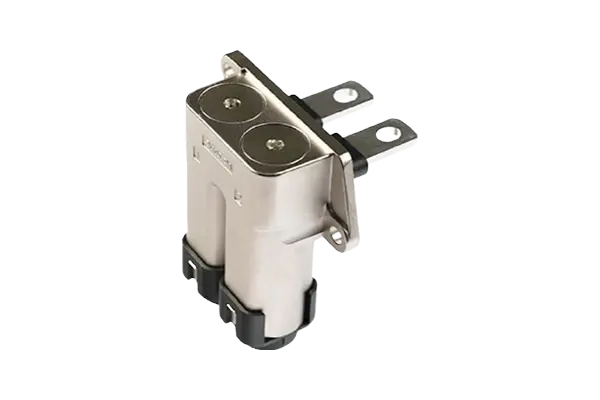
Two-Core Elbow Through Hole Metal Connector
The DUOSIDA Two-Core Elbow Through Hole Metal Connector is an option to evaluate when the application requires a two-core connector configuration with an angled connection arrangement.
During selection, engineers should confirm the required electrical connection paths, cable specifications, connector dimensions, and mounting conditions. It is also important to check the available space around the cable exit and ensure that the proposed arrangement works with the enclosure design.
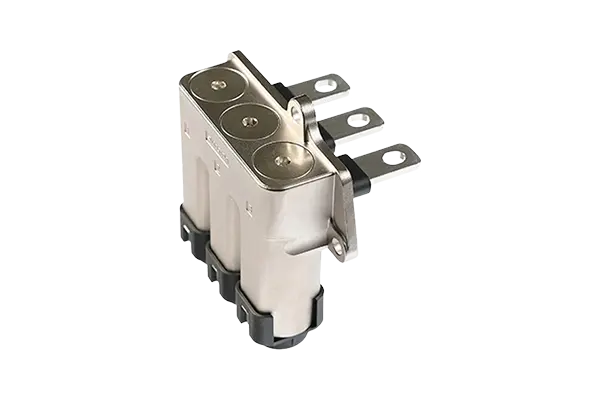
Three-Core Elbow Through Hole Metal Connector
For projects requiring a three-core configuration, buyers can review the DUOSIDA Three-Core Elbow Through Hole Metal Connector.
The additional core changes the connection configuration, so engineers should verify that the product matches the system's wiring design and electrical requirements. The number of cores alone does not establish whether a connector is suitable for a particular application.
When comparing the two products, review their official technical drawings and specifications individually. Do not assume that they share the same current rating, voltage rating, dimensions, cable range, or protection characteristics.
Four Design Factors That Influence Connector Selection
Rather than starting with a product name, engineering teams can evaluate an elbow connector through four practical design questions.
1. Does the cable exit direction fit the layout?
Start by reviewing the enclosure drawing and identifying the available space around the connection point. Consider nearby components, cable routing paths, and the room required for installation.
An elbow configuration may help accommodate a particular cable direction, but the overall assembly still needs sufficient clearance. The cable must also be routed according to its specified minimum bend radius to avoid unnecessary mechanical stress.
2. Does the mounting arrangement match the enclosure?
A through-hole connector needs to fit the intended panel or enclosure interface. Check the mounting dimensions, hole position, panel thickness, fastening method, and sealing arrangement where applicable.
These details should be confirmed before the enclosure design is finalized. If the connector is being used to replace an existing component, compare the original dimensions and mounting interface rather than relying on the product description alone.
3. Are the electrical specifications suitable?
Rated voltage, current, conductor configuration, and cable compatibility should be confirmed against the application requirements.
The engineering team should also consider operating temperature and the expected electrical load. Actual performance depends on the complete connection system, including cable selection, termination quality, and installation conditions.
For projects with defined compliance or validation requirements, request the relevant technical documents and verify that the selected connector meets the project's acceptance criteria.
4. Can the connector be installed and maintained efficiently?
Installation access is often overlooked during early product selection. Consider whether technicians can reach the fastening points, complete the cable termination, and inspect the connection during assembly.
A design that is electrically suitable may still create production difficulties if the connector is difficult to install within the available space. Reviewing the proposed connector in the context of the complete assembly can help identify these issues earlier.
From Product Selection to System Integration
Connector selection should not end when a model has been identified. The next step is to verify that the component can be integrated into the equipment as intended.
A practical evaluation process can follow this sequence:
Define the electrical requirements. Confirm the required connection configuration, rated voltage, current, and cable specifications.
Review the mechanical layout. Check mounting dimensions, cable exit direction, available clearance, and enclosure compatibility.
Compare candidate products. Review the two-core and three-core configurations where both are relevant to the design.
Request technical documentation. Confirm the current product drawings, specifications, and applicable test information.
Evaluate the selected configuration. Use samples and project-specific validation procedures where required before approving the component for production.
This approach helps engineering and procurement teams work from the same requirements. It also gives the supplier a clearer understanding of the project, making it easier to discuss compatibility questions before the design is fixed.
What Overseas Buyers Should Ask a Connector Supplier
For international OEMs, component distributors, and system integrators, a clear technical inquiry is an important part of sourcing. Sending only the product name may not provide enough information to assess whether a connector is suitable.
When contacting a supplier about an elbow through-hole metal connector, prepare the following information:
Intended equipment or application
Required number of connection cores
Rated voltage and operating current
Cable type and conductor cross-section
Mounting dimensions or an enclosure drawing
Available space and required cable routing direction
Operating environment and applicable validation requirements
If the project has a fixed design, attaching a drawing can help clarify the mounting arrangement. If the project is still under development, identify which requirements are confirmed and which need further evaluation.
Buyers should also request clarification whenever a product specification is missing. For example, a metal housing or through-hole structure should not automatically be taken as proof of a particular protection rating or environmental performance. Those characteristics need to be confirmed through the relevant product documentation.
DUOSIDA's Broader EV Connection Product Range
Zhangjiagang UCHEN New Energy Technology Co., Ltd. (Youcheng Technology, stock code: 873087) focuses on high-performance charging products for new energy vehicles. Its DUOSIDA portfolio includes charging plugs, charging sockets, high-power charging products, NACS products, vehicle outlet sockets, charging stations, and high-voltage connectors.
For buyers managing several EV-related components, this broader range provides a starting point for exploring products across different connection and charging requirements. However, each component must be evaluated according to its intended function and technical specifications.
The two-core and three-core elbow through-hole metal connectors can be reviewed through their respective product pages:
For additional product information, visit the DUOSIDA official website.
Conclusion
An elbow through hole metal connector is worth evaluating when the connection direction and mounting arrangement are important parts of an electrical system's mechanical design. Choosing the right configuration requires checking the available space, cable routing, mounting interface, electrical requirements, and relevant technical documentation.
DUOSIDA offers two-core and three-core elbow through-hole metal connector options for buyers to evaluate against their project needs. By comparing the product specifications and sharing clear application requirements with the supplier, engineering teams and procurement professionals can make more informed decisions and reduce avoidable integration problems.