
How to Choose the Right EV Charging Socket for Different Vehicle Applications
 2026-07-23

As electric vehicles become more common across passenger transportation, commercial logistics, public transit, and industrial fleets, selecting the right EV charging socket has become an important engineering decision. A charging socket is more than a connection point between a vehicle and a charger—it directly affects charging compatibility, safety, reliability, and future scalability.
Different vehicle applications require different charging solutions. A compact passenger EV typically has different charging needs than an electric bus, while a high-performance commercial vehicle often requires a high-current DC charging interface instead of a standard AC charging socket.
For vehicle manufacturers, charging station builders, OEM suppliers, and system integrators, understanding how to choose the correct charging socket can help reduce development risks and improve compatibility with target markets.
As a manufacturer specializing in high-performance charging products for new energy vehicles, DUOSIDA develops charging sockets, vehicle inlets, charging plugs, high-voltage connectors, and complete charging connection solutions for customers worldwide. Its products are designed to support multiple international charging standards and are widely used in electric passenger cars, commercial vehicles, charging stations, and energy infrastructure.
Why Charging Socket Selection Matters
Every electric vehicle is designed around a specific charging architecture. Choosing an unsuitable charging socket may lead to compatibility issues, charging inefficiency, or additional engineering modifications.
When selecting a charging socket, engineers should evaluate:
· Vehicle type
· Charging standard
· AC or DC charging requirements
· Charging current
· Installation space
· Future upgrade possibilities
· Regional regulations
The optimal charging socket should balance electrical performance, durability, safety, and market compatibility.
Passenger Electric Vehicles
Passenger EVs account for the largest portion of the global electric vehicle market. Most passenger vehicles support both home charging and public charging.
For AC charging, Type 2 sockets have become the preferred solution in Europe and many international markets.
Manufacturers usually select charging sockets based on charging power requirements.
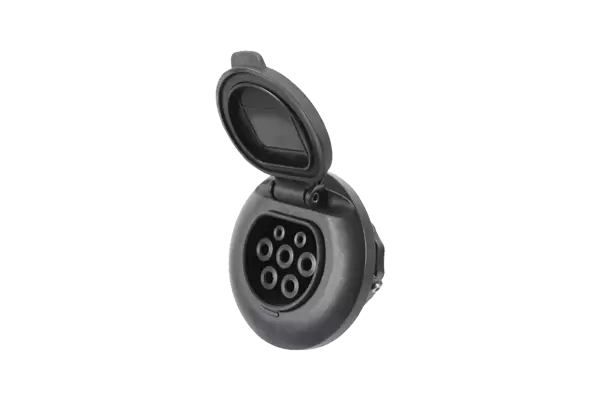
For standard passenger vehicles requiring multiple current options, a Type 2 AC Socket (16A/20A/32A) provides a practical solution for residential and commercial charging applications.
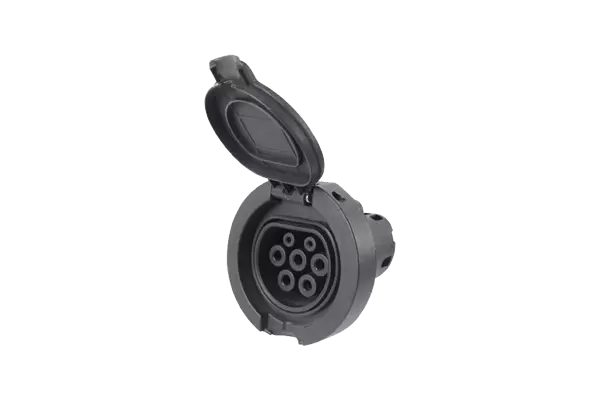
For vehicles requiring higher charging capacity, the Type 2 AC Socket (16A/20A/32A/50A) offers greater flexibility for different charging scenarios.
Premium Passenger Vehicles
Premium electric vehicles generally require higher charging performance while maintaining compatibility with public charging infrastructure.
Many premium EV platforms support higher AC charging currents to reduce charging time.
For these applications, manufacturers often choose a Type 2 AC Socket supporting 16A, 32A, 50A and 63A.
Higher current capability allows vehicle manufacturers to support various charging environments while maintaining compatibility with future charging infrastructure upgrades.
Commercial Electric Vehicles
Commercial delivery vans, logistics vehicles, and utility fleets generally operate on intensive daily schedules.
Downtime directly affects operating efficiency, making charging speed an important factor.
Many commercial EVs therefore combine AC charging for overnight charging with DC fast charging during daily operation.
When designing commercial EV charging systems, manufacturers should consider:
· Daily mileage
· Charging frequency
· Fleet operation schedule
· Battery capacity
· Available charging infrastructure
Charging sockets must withstand repeated connection cycles while maintaining stable electrical performance.
Electric Buses and Heavy-Duty Vehicles
Electric buses and heavy commercial trucks typically require high-current DC charging.
These vehicles usually have larger battery packs and shorter charging windows.
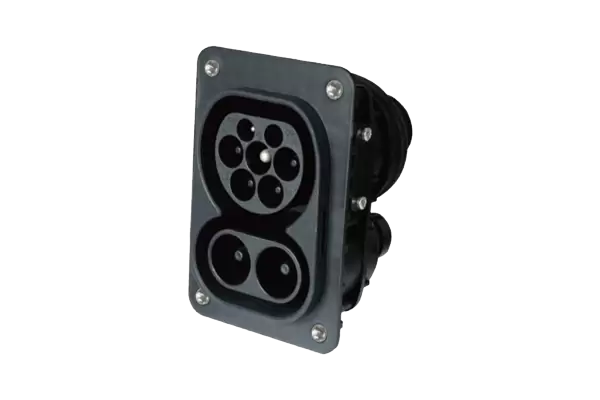
For these applications, CCS2 has become one of the preferred charging standards in many international markets.
DUOSIDA offers a CCS2 Vehicle Inlet (80A–200A DC) designed for high-power charging applications where fast charging and long-term reliability are essential.
Its high-current capability makes it suitable for:
· Electric buses
· Commercial trucks
· Logistics fleets
· Public transportation
· High-power charging stations
Charging Stations
Charging stations must accommodate different vehicle types while ensuring stable operation under continuous use.
When selecting charging sockets for charging equipment, several factors should be evaluated:
Current Rating
Different charging stations require different output capacities.
Lower-power stations may only require standard AC charging sockets, while public charging stations often need higher current configurations.
Environmental Protection
Outdoor charging stations face rain, dust, sunlight, and temperature changes.
Charging sockets should provide excellent environmental protection and mechanical durability.
Installation Requirements
Compact design simplifies equipment integration and maintenance.
Reliable locking mechanisms also improve charging safety.
Choosing Between AC and DC Charging Sockets
One of the most common questions from equipment manufacturers is whether to use AC charging sockets or DC vehicle inlets.
AC Charging Sockets
Suitable for:
· Home charging
· Office charging
· Residential communities
· Hotels
· Shopping centers
· Workplace charging
Advantages include:
· Lower installation complexity
· Lower charging power requirements
· Broad compatibility
· Cost-effective infrastructure deployment
DC Vehicle Inlets
Suitable for:
· Highway charging stations
· Fleet charging
· Commercial vehicles
· Long-distance travel
· Public fast charging
Advantages include:
· Faster charging
· Higher charging power
· Reduced vehicle downtime
· Better commercial fleet efficiency
The choice depends primarily on the intended charging scenario rather than simply the vehicle category.
Vehicle Inlet or Charging Socket?
Although the terms are sometimes used interchangeably, they serve different purposes.
A charging socket is generally mounted on charging equipment or infrastructure.
A vehicle inlet is installed on the vehicle itself and receives power from the charging connector.
For manufacturers developing complete EV charging systems, selecting compatible sockets and vehicle inlets ensures safe electrical communication and reliable charging performance.
DUOSIDA also provides Type 2 AC Vehicle Inlets (16A/20A/32A) and Type 2 AC Vehicle Inlets (16A/32A) for passenger vehicles and commercial EV platforms requiring dependable AC charging interfaces.
Key Selection Factors
Regardless of vehicle type, several technical considerations remain important.
Charging Standard
Always confirm whether the target market requires Type 2, CCS2, GB/T, Type 1, CCS1, CHAdeMO, or another charging standard.
Current Capacity
The charging socket should safely support the vehicle's maximum charging current without overheating during long-term operation.
Mechanical Durability
Fleet vehicles may connect and disconnect several times every day.
Durability directly affects maintenance costs and operational reliability.
Weather Resistance
Charging components should withstand outdoor environments including moisture, dust, vibration, and temperature fluctuations.
Certification
Products should comply with applicable international standards and quality requirements for automotive applications.
Why Choose DUOSIDA?
Selecting a charging socket supplier is as important as selecting the charging socket itself.
DUOSIDA focuses on high-performance charging products for new energy vehicles and offers a comprehensive portfolio covering AC charging sockets, DC vehicle inlets, charging plugs, high-voltage connectors, and customized charging solutions.
Its products are tested to meet international certification requirements and are supplied to vehicle manufacturers, charging equipment companies, and OEM customers worldwide.
With continuous product development and manufacturing experience, DUOSIDA helps customers build charging systems that support today's electric vehicles while remaining prepared for future charging technologies.
Conclusion
There is no single charging socket suitable for every electric vehicle application.
Passenger cars, commercial fleets, buses, trucks, and charging stations each have different charging requirements, current ratings, and operating environments.
By understanding charging standards, vehicle architecture, charging scenarios, and future expansion plans, manufacturers can select charging sockets that improve safety, compatibility, and long-term product performance.
Working with an experienced charging solution provider such as DUOSIDA gives OEMs and charging infrastructure developers access to reliable charging products designed for global electric vehicle markets.